Shaker vs. Flat-Panel Cabinets: Which Style Is Right for Your Kitchen?
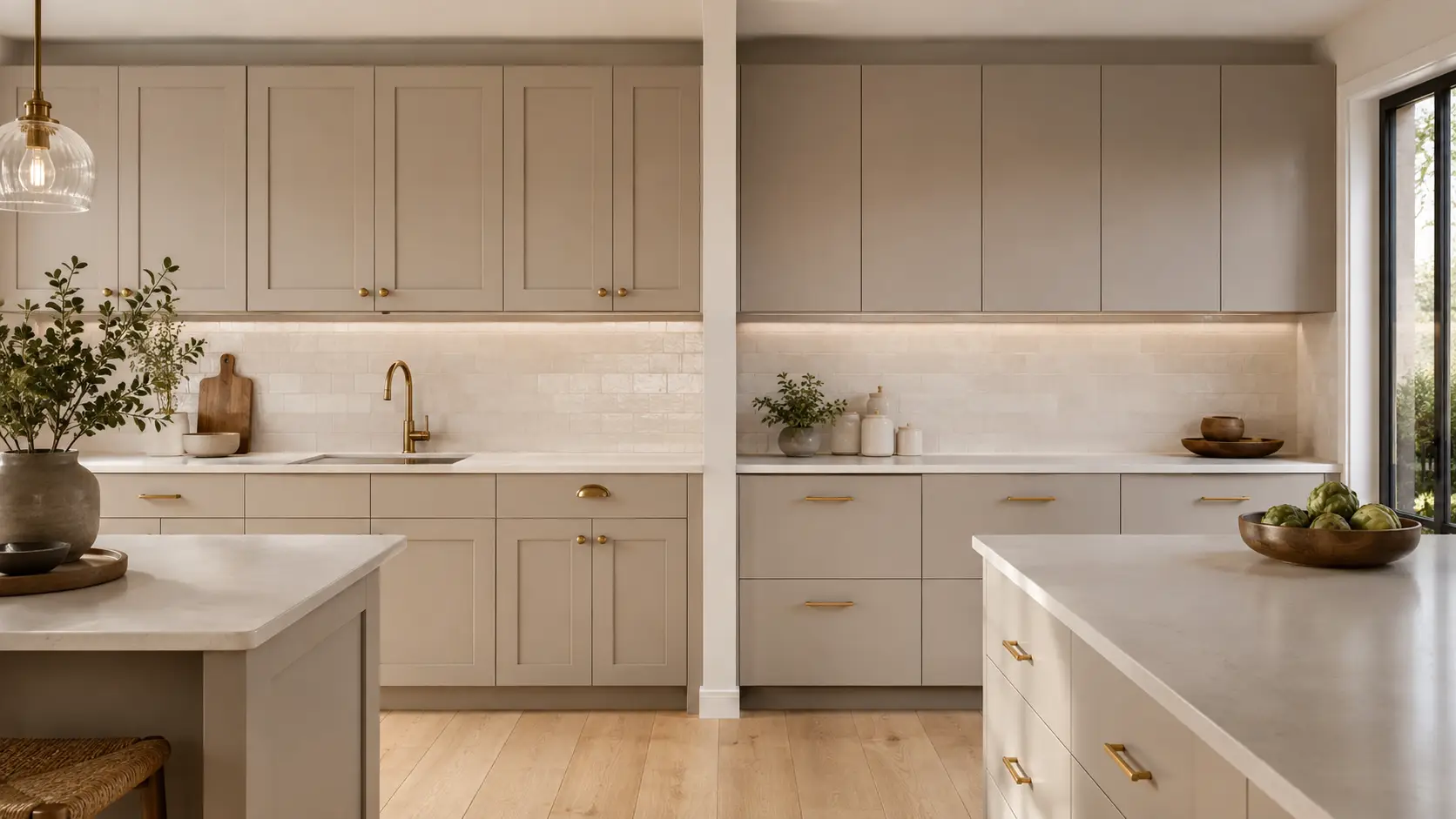
Choosing between Shaker cabinets vs. flat-panel cabinets is one of the most important visual decisions in a kitchen remodel. Cabinet doors cover a large portion of the room, so their profile affects the kitchen’s character, perceived size, maintenance needs, and relationship with the rest of the home.
Shaker cabinets introduce subtle framing and architectural depth. Flat-panel cabinets create a smoother, more continuous appearance. Neither is automatically more timeless or higher quality, the right option depends on your architecture, lifestyle, materials, and preferred level of visual detail.
Before selecting your kitchen cabinetry, compare how each door style will function throughout the entire room, not only how one sample looks in isolation.
What Current Kitchen Research Shows
Shaker remains the most widely selected cabinet-door style among renovating homeowners. The 2025 U.S. Houzz Kitchen Trends Study found that 61% of homeowners chose Shaker-style doors, compared with 22% who selected flat-panel doors and 12% who selected raised-panel designs.
At the same time, flat-panel cabinetry is gaining attention in forward-looking kitchen design. The NKBA’s 2026 Kitchen Trends Report found that 69% of surveyed professionals identified flat slab cabinet doors as a feature expected to gain popularity, alongside minimalist layouts and integrated appliances.
Together, these findings suggest that Shaker remains the established favorite, while flat-panel cabinetry is an increasingly important choice for contemporary and visually quiet kitchens.
First, Understand the Difference
A Shaker-style door has a simple rectangular frame surrounding a recessed center panel. It provides definition without the carving or ornamentation found on many traditional raised-panel doors.
A flat-panel, or slab, door has a smooth front with no raised or recessed center panel. MasterBrand distinguishes the two by describing Shaker doors as simple recessed-panel designs and slab doors as flat surfaces that are neither raised nor recessed.
The phrase flat panel can occasionally cause confusion because some manufacturers also use it to describe the flat center panel inside a framed door. When speaking with a showroom consultant, clarify whether you mean:
- A five-piece recessed-panel Shaker door
- A completely smooth slab door
Option A: Shaker Cabinets
What Do Shaker Cabinets Look Like?
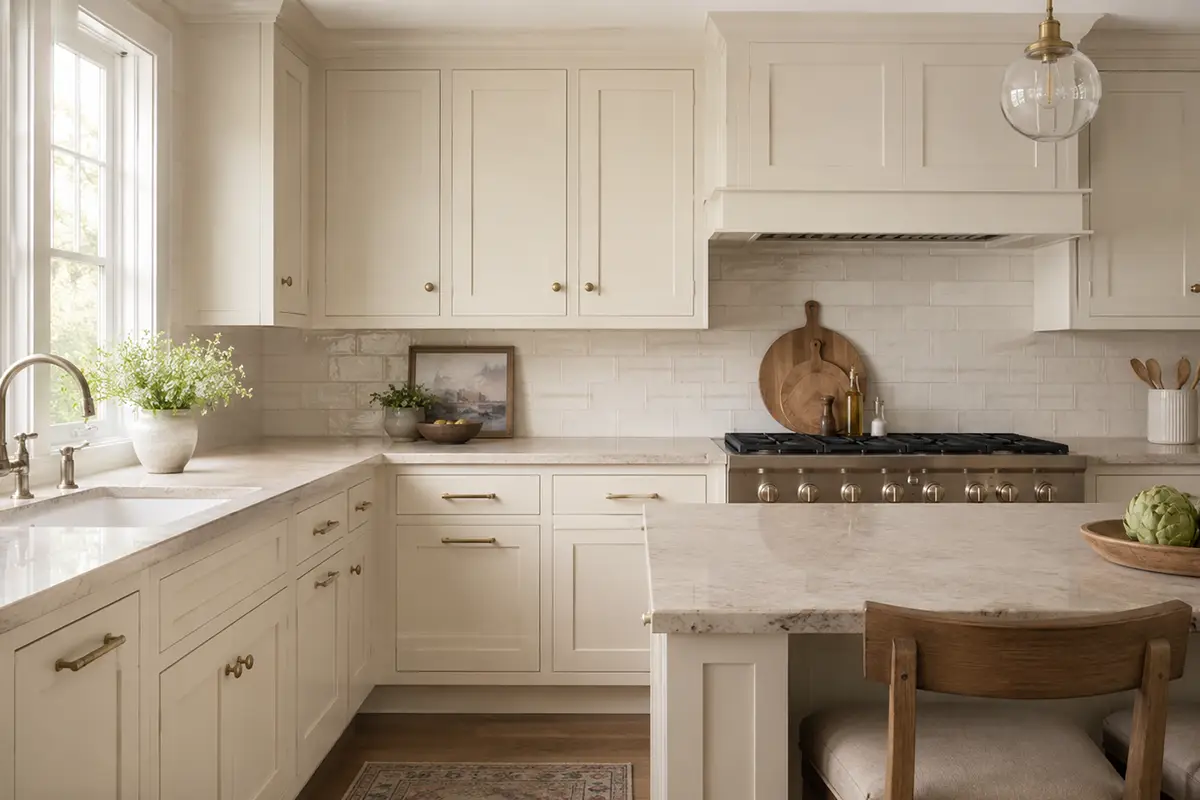
Shaker cabinets feature rails and stiles forming a rectangular frame around a recessed center panel. The design is structured but restrained, making it less ornate than traditional cabinetry and more detailed than a slab front.
Not all Shaker doors look the same. The width of the frame has a significant effect:
- Standard Shaker: wider rails and stiles with a classic, substantial appearance
- Slim Shaker: narrower framing with a cleaner, more contemporary character
- Shaker with slab drawers: framed doors paired with smooth drawer fronts
- Five-piece drawer Shaker: matching framed profiles on doors and drawers
Always review the exact door style on several cabinet sizes before ordering.
Why Shaker Cabinets Remain Popular
They adapt to many design styles
Shaker cabinets can work in:
- Transitional kitchens
- Classic interiors
- Modern farmhouse homes
- Organic-modern kitchens
- Coastal spaces
- Updated traditional homes
Their appearance changes according to the finish and surrounding materials. Warm white Shaker doors can feel classic, while slim white-oak Shaker cabinets can feel clean and contemporary.
They add architectural depth
The recessed panel creates subtle shadow lines across the cabinetry. This helps define large cabinet walls and adds structure without requiring decorative molding or carving.
Shaker doors can be particularly effective when paired with:
- Quiet countertops
- Simple backsplashes
- Paneled appliances
- Traditional trim
- Furniture-style islands
- Glass-front accent cabinets
They offer broad hardware flexibility
Shaker cabinets coordinate easily with many hardware styles:
- Traditional knobs
- Cup pulls
- Short bar pulls
- Long contemporary pulls
- Brass, bronze, nickel, or black finishes
Changing the hardware in the future can refresh the kitchen without replacing the cabinetry.
They bridge traditional and modern design
A standard Shaker profile tends to feel more classic, while a slim Shaker profile can create a cleaner and more architectural appearance.
This makes Shaker useful for homeowners who want an updated kitchen that still feels connected to the age or architecture of the home.
Potential Drawbacks of Shaker Cabinets
They require more detailed cleaning
The inside edges surrounding the recessed panel can collect dust, crumbs, or cooking residue. Routine cleaning is still straightforward, but it takes slightly more attention than wiping a completely smooth slab door.
Wide frames can create visual busyness
In a kitchen with many narrow doors and drawers, Shaker framing introduces repeated horizontal and vertical lines.
This can feel crowded when combined with:
- Highly patterned countertops
- Decorative backsplash tile
- Elaborate hardware
- Extensive molding
- Many small cabinet sections
A slim Shaker profile or slab drawer front can reduce that visual weight.
Door proportions matter
A frame that looks elegant on a tall pantry door may feel compressed on a narrow cabinet or shallow drawer.
Ask to see the chosen profile on:
- Small drawer fronts
- Wide drawers
- Narrow wall cabinets
- Tall pantry cabinets
- Appliance panels
Shaker Cabinets Are Best For
Shaker may be the stronger choice when you want:
- Architectural detail without ornament
- A transitional or classic foundation
- Flexibility with hardware and finishes
- A style that works with changing décor
- Broad appeal for future resale
- A balance between traditional and contemporary design
Option B: Flat-Panel Cabinets
What Do Flat-Panel Cabinets Look Like?
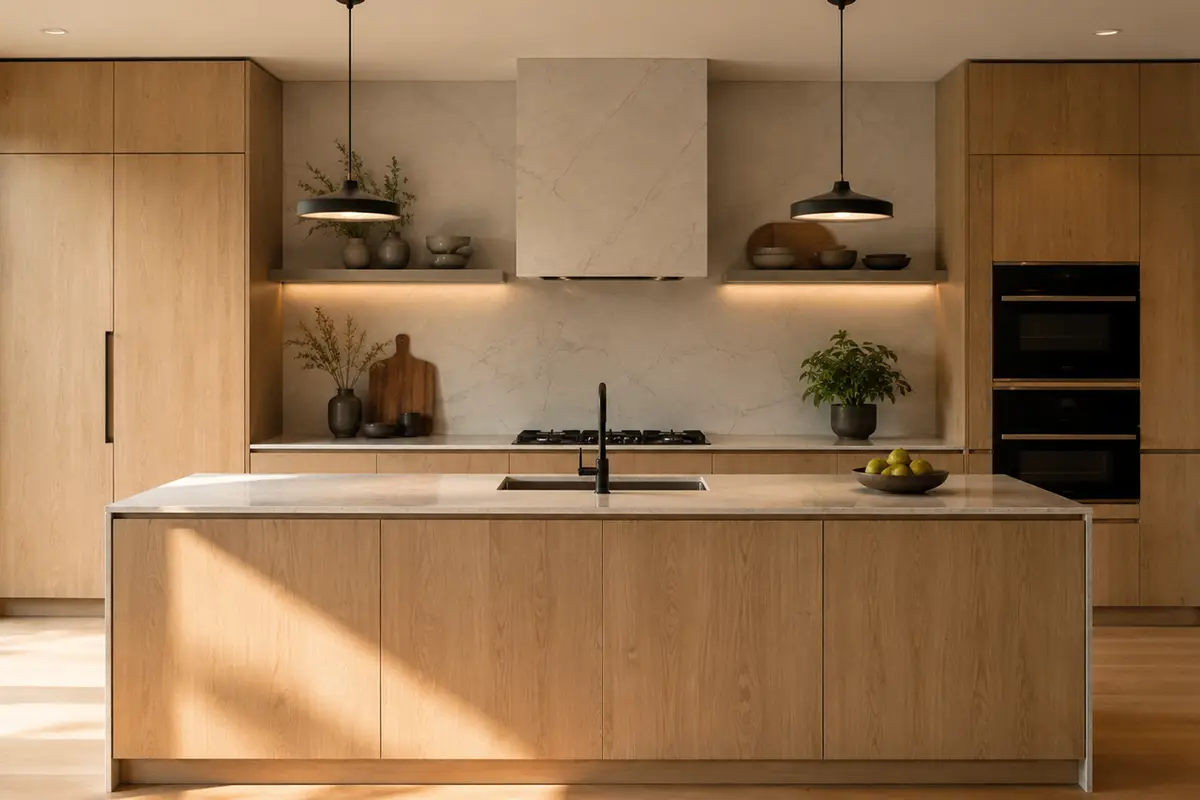
Flat-panel cabinets use smooth slab doors without a separate surrounding frame or recessed center.
Because the surface is uninterrupted, the eye focuses more strongly on:
- Cabinet proportions
- Alignment
- Wood grain
- Finish quality
- Door spacing
- Hardware placement
- Material texture
Flat-panel doors are often paired with frameless cabinet construction to create tighter reveals and a more continuous façade.
Why Homeowners Choose Flat-Panel Cabinets
They create a cleaner visual field
Flat-panel doors reduce the number of lines across the room. This can make cabinetry feel quieter, more integrated, and more architectural.
They are especially effective when the kitchen already contains a strong focal point, such as:
- Dramatic stone
- A full-height backsplash
- Sculptural lighting
- A statement island
- Strong wood grain
- Large architectural windows
They showcase materials
A broad slab surface is ideal for highlighting:
- Natural oak or walnut veneer
- Sequence-matched wood grain
- Matte paint
- Textured laminate
- Acrylic
- High-gloss finishes
- Engineered wood surfaces
MasterBrand notes that contemporary cabinet materials such as veneer, laminate, and acrylic can offer consistent color, grain, and finish options.
With natural wood slab doors, the grain itself becomes a primary design feature.
They are generally quicker to wipe
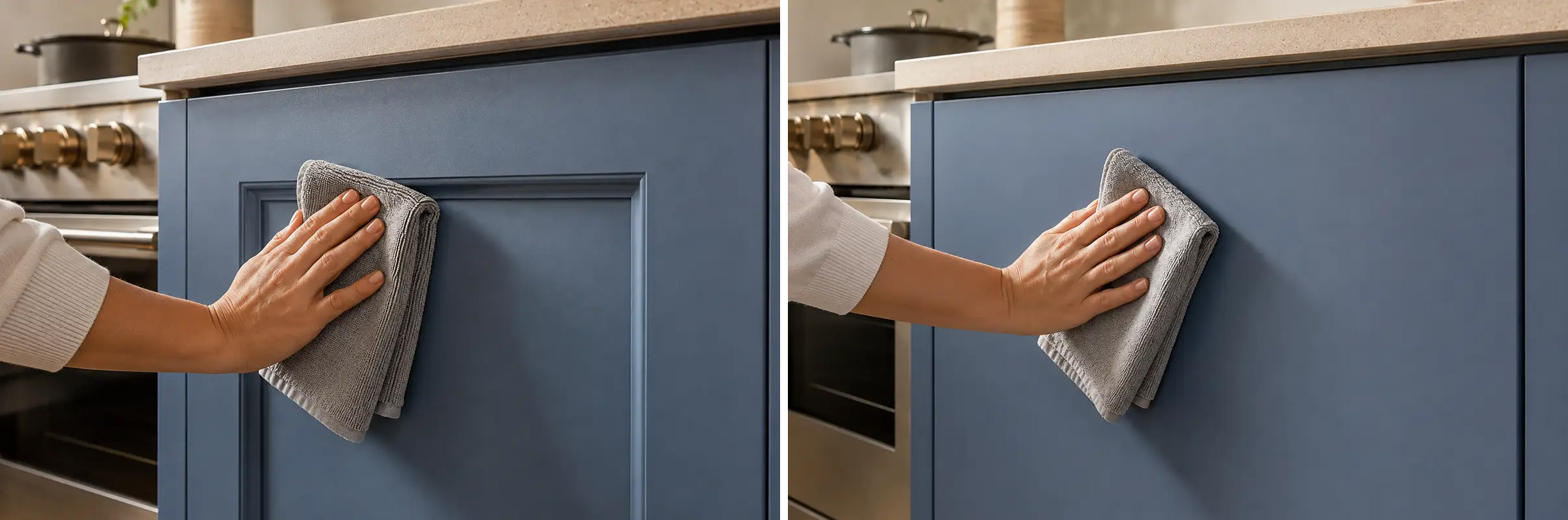
A flat surface has no recessed corners or frame edges. This can make routine cleaning simpler.
However, the finish still matters. Dark matte doors may reveal fingerprints, while glossy doors may show reflections and smudges more readily.
They work well in compact kitchens
Flat-panel fronts can reduce repeated visual interruptions in a small room. They may help a compact kitchen feel calmer, especially when paired with a light or medium finish and consistent hardware.
They do not automatically make the room larger, though. Lighting, contrast, cabinet height, and layout remain equally important.
Potential Drawbacks of Flat-Panel Cabinets
Alignment must be precise
Simple cabinet fronts make inconsistencies easier to notice. Uneven gaps, misaligned drawers, or poorly placed fillers can stand out more clearly than they might on a detailed door.
Professional measurement and installation are particularly important.
Some combinations can feel cold
Flat-panel cabinets are not inherently cold, but an all-white glossy kitchen with cool lighting and minimal texture may feel clinical.
To create warmth, consider pairing slab doors with:
- Natural wood
- Warm stone
- Brass or bronze hardware
- Textured tile
- Soft lighting
- Handmade accessories
- Low-sheen finishes
Edge quality becomes more visible
Because slab doors do not have a frame, their edges are an important part of the finished appearance.
Ask:
- Is the door solid wood, MDF, veneer, laminate, or acrylic?
- How are the edges finished?
- Is edge banding visible?
- Can grain be matched across adjoining fronts?
- Is the finish repairable?
- Are replacement doors available?
Handleless systems require planning
Flat-panel kitchens are often shown without visible hardware, but handleless cabinetry may require:
- Integrated channels
- Finger pulls
- Push-to-open mechanisms
- Recessed rails
- Additional appliance coordination
Test the system in person. A minimal appearance is not useful if the doors feel uncomfortable to open every day.
Flat-Panel Cabinets Are Best For
Flat-panel cabinetry may suit:
- Contemporary kitchens
- Minimal interiors
- Mid-century-inspired homes
- Modern open-concept spaces
- Small kitchens needing less visual interruption
- Natural wood designs where grain is the focal point
- Homeowners who prioritize quick surface cleaning
- Projects with integrated appliances and precise architectural lines
Shaker vs. Flat-Panel Cabinets: Side-by-Side Comparison
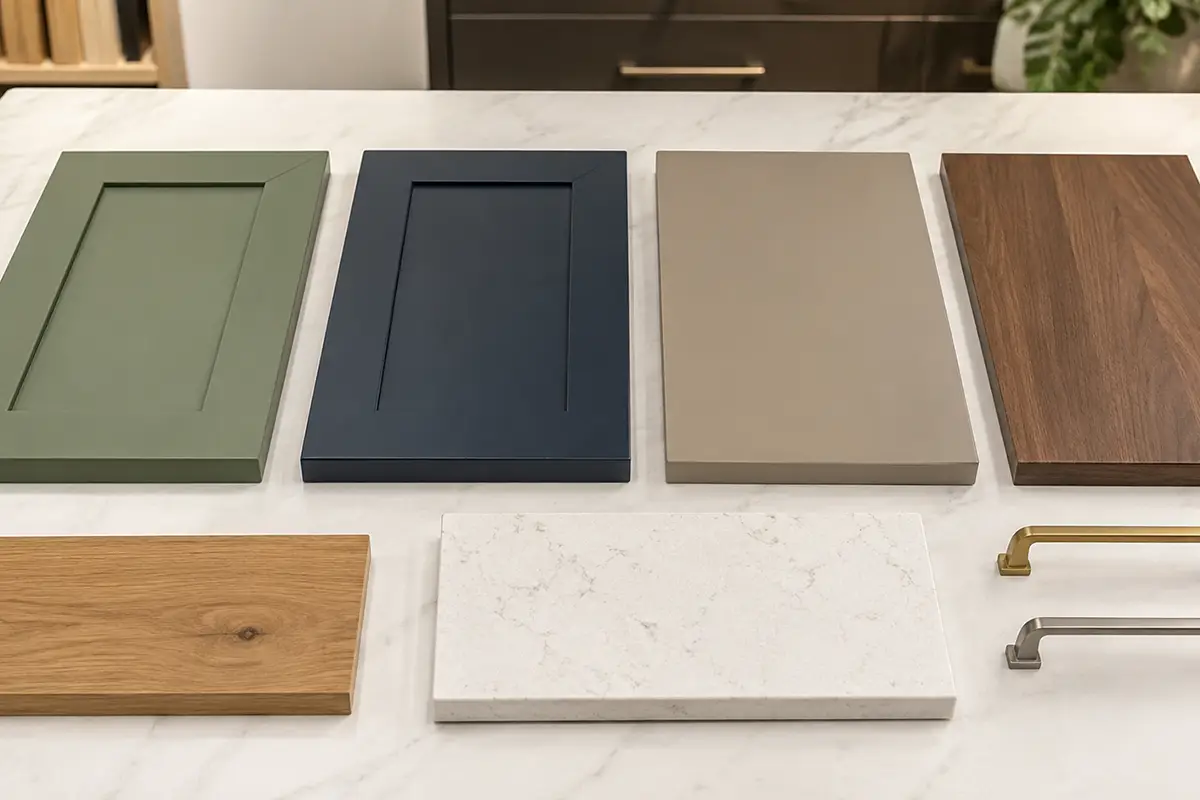
Comparing cabinet doors under the same lighting makes differences in profile, material, and visual weight easier to see.
| Consideration | Shaker Cabinets | Flat-Panel Cabinets |
| Appearance | Framed and dimensional | Smooth and uninterrupted |
| Typical direction | Transitional, classic, farmhouse | Modern, contemporary, minimal |
| Visual detail | More shadow lines and structure | Fewer lines and less interruption |
| Cleaning | Frame edges require more attention | Smooth fronts are generally quicker to wipe |
| Material emphasis | Highlights profile and craftsmanship | Highlights color, grain, and finish |
| Hardware | Works with traditional or modern hardware | Often paired with minimal or integrated pulls |
| Small kitchens | Slim Shaker can work well | Creates a quieter façade |
| Installation | Alignment still matters | Small alignment issues may be more visible |
| Natural wood | Adds depth and visible construction | Allows grain to become the main feature |
| Style flexibility | Broad and highly adaptable | Strongly shaped by finish and material |
For a Busy Family Kitchen
Either style can work, but finish selection may matter more than the door profile.
Consider:
- A durable low-sheen finish
- Medium or softened colors
- Easy-to-grasp hardware
- Full-extension drawers
- Soft-close hinges
- Manufacturer-approved cleaning products
Flat-panel fronts may be faster to wipe, but a very dark matte slab can show fingerprints more easily than a medium-tone Shaker door.
For a Transitional Home
Shaker is often the most natural fit because it connects updated materials with traditional architectural details.
Consider:
- Standard or slim Shaker doors
- Warm white, mushroom, sage, or natural wood
- Simple brass, nickel, or black hardware
- Quiet stone
- Restrained backsplash patterns
For a Modern Home
Flat-panel cabinets typically support contemporary architecture more naturally.
Consider:
- Frameless cabinet construction
- Full-overlay slab doors
- Natural oak or walnut
- Matte painted finishes
- Integrated appliances
- Minimal pulls
- Carefully aligned horizontal and vertical lines
The NKBA’s 2026 report supports this direction, identifying minimalism, slab cabinet doors, integrated appliances, and solid-surface backsplashes as features expected to grow.
For a Homeowner Seeking a Timeless Kitchen
Shaker has the stronger historical association with classic American cabinetry and currently has the broadest homeowner adoption.
However, flat-panel cabinets can also age beautifully when they use:
- Natural materials
- Warm colors
- Thoughtful proportions
- Quality hardware
- Precise installation
- Restrained detailing
A trend-heavy finish is more likely to date a kitchen than the slab door itself.
For a Small Kitchen
Flat-panel fronts may reduce visual repetition, especially in a light or medium tone.
A slim Shaker door can provide a similar sense of simplicity while retaining subtle architectural depth.
Good options for compact kitchens include:
- Light oak
- Warm white
- Soft mushroom
- Muted blue-gray
- Pale sage
For Natural Wood Cabinetry
Choose Shaker when you want visible structure and furniture-like craftsmanship.
Choose flat-panel when you want uninterrupted grain to become the central design feature.
For slab doors, ask whether the veneer can be sequence-matched across nearby doors and drawers.
For a Home With Traditional Architecture
Shaker cabinetry often connects more naturally with:
- Crown molding
- Arched openings
- Paneled walls
- Traditional window trim
- Historic architecture
Flat-panel cabinetry can still work, but materials such as warm wood, natural stone, and aged metal can help bridge the contrast between contemporary cabinets and traditional surroundings.
Can You Mix Shaker and Flat-Panel Cabinets?
Yes. The combination should feel intentional rather than accidental.
Possible approaches include:
- Shaker perimeter cabinets with a slab-front island
- Shaker doors with slab drawer fronts
- Flat-panel cabinetry with one framed furniture-style section
- Slim Shaker upper cabinets with slab base drawers
- Shaker pantry cabinets with a flat-panel beverage center
When combining profiles, keep at least two elements consistent:
- Cabinet color
- Finish
- Hardware
- Wood species
- Countertop
- Door proportions
Avoid mixing multiple door styles, multiple cabinet colors, several metals, dramatic stone, and patterned tile at the same time. Establish one clear focal point.
Common Cabinet-Style Mistakes
Yes. The combination should feel intentional rather than accidental.
Possible approaches include:
- Shaker perimeter cabinets with a slab-front island
- Shaker doors with slab drawer fronts
- Flat-panel cabinetry with one framed furniture-style section
- Slim Shaker upper cabinets with slab base drawers
- Shaker pantry cabinets with a flat-panel beverage center
When combining profiles, keep at least two elements consistent:
- Cabinet color
- Finish
- Hardware
- Wood species
- Countertop
- Door proportions
Avoid mixing multiple door styles, multiple cabinet colors, several metals, dramatic stone, and patterned tile at the same time. Establish one clear focal point.
Showroom Checklist
Bring the following when comparing cabinet styles:
- Kitchen measurements
- Photos of the room
- Flooring sample
- Countertop sample
- Backsplash ideas
- Appliance finishes
- Hardware preferences
- Inspiration images
- Photos of adjoining rooms
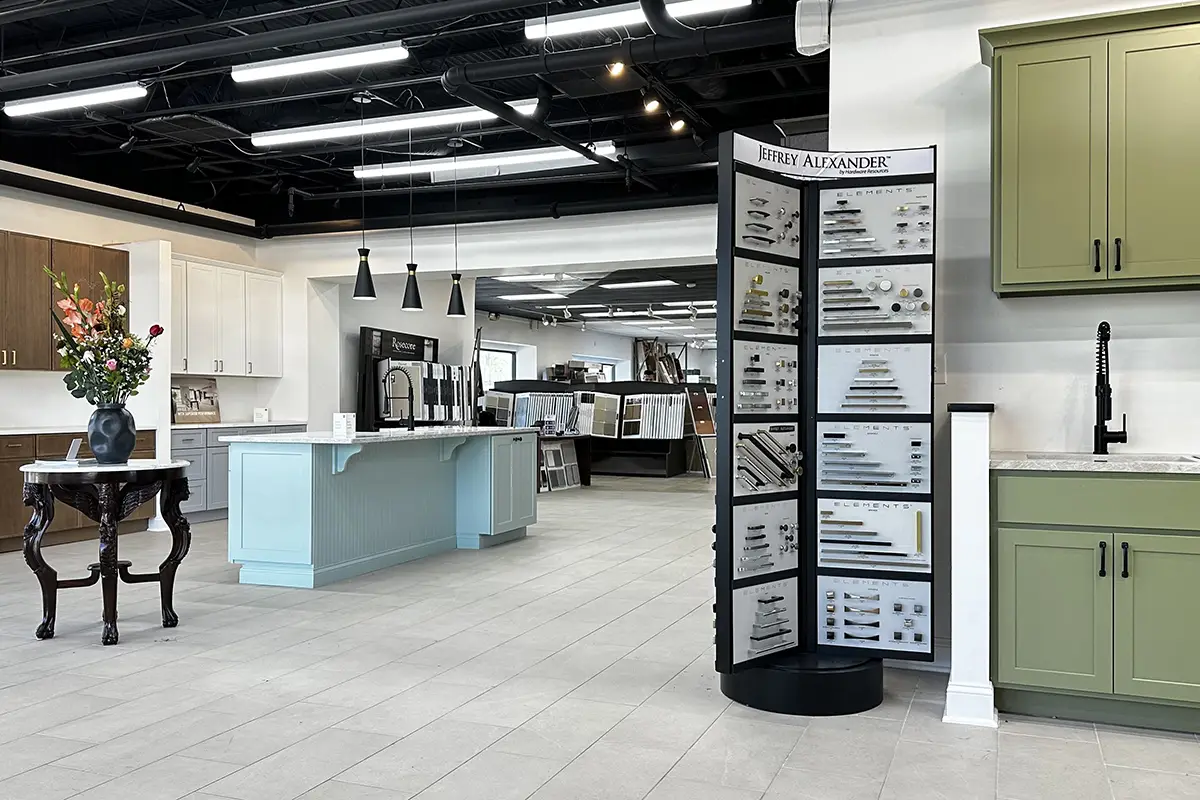
Ask to compare:
- Standard Shaker
- Slim Shaker
- Painted Shaker
- Stained-wood Shaker
- Painted slab
- Wood-grain slab
- Matte and gloss finishes
- Framed and frameless construction
- Slab and five-piece drawer fronts
Questions to ask:
- What material is used for the door?
- What material is used for the center panel?
- How wide are the Shaker rails and stiles?
- Is the drawer front slab or five-piece?
- Is the cabinet framed or frameless?
- Is the door full overlay, partial overlay, or inset?
- How are slab-door edges finished?
- Are touch-up products available?
- Which cleaning products are approved?
- What does the warranty cover?
During an interior design consultation, cabinet-door samples can be compared with countertops, flooring, tile, paint, and hardware before the order is finalized.
Final Recommendation
Choose Shaker cabinets when you want:
- Subtle architectural detail
- Broad design flexibility
- A transitional or classic foundation
- Compatibility with many hardware styles
- A cabinet profile with wide homeowner appeal
Choose flat-panel cabinets when you want:
- A quieter visual surface
- Clean architectural lines
- A contemporary or minimal direction
- Greater emphasis on wood grain or finish
- Smooth fronts for easier routine wiping
When you appreciate both styles, slim Shaker cabinetry can provide an effective middle ground. It retains the framed profile and depth of Shaker while creating a cleaner, more contemporary appearance. The best cabinet style is not simply the one receiving the most attention online. It is the style that fits your home’s architecture, supports your materials, and works comfortably with the way you use the kitchen.
Explore our kitchen remodeling services and custom kitchen cabinetry for additional planning information.
For more remodeling guidance, read How to Plan a Kitchen Remodel Without Stress in the DMV Area or explore more kitchen and interior design articles.
Visit the Karpet King Design Center showroom in Rockville to compare Shaker, slim Shaker, and flat-panel cabinet doors alongside countertops, flooring, tile, and hardware.
Book a showroom consultation or contact Karpet King Design Center in Rockville, Maryland.