How to Choose Kitchen Cabinet Colors That Will Still Look Beautiful in 10 Years

How to Choose Kitchen Cabinet Colors That Will Still Look Beautiful in 10 Years
How to Choose Kitchen Cabinet Colors That Will Still Look Beautiful in 10 Years

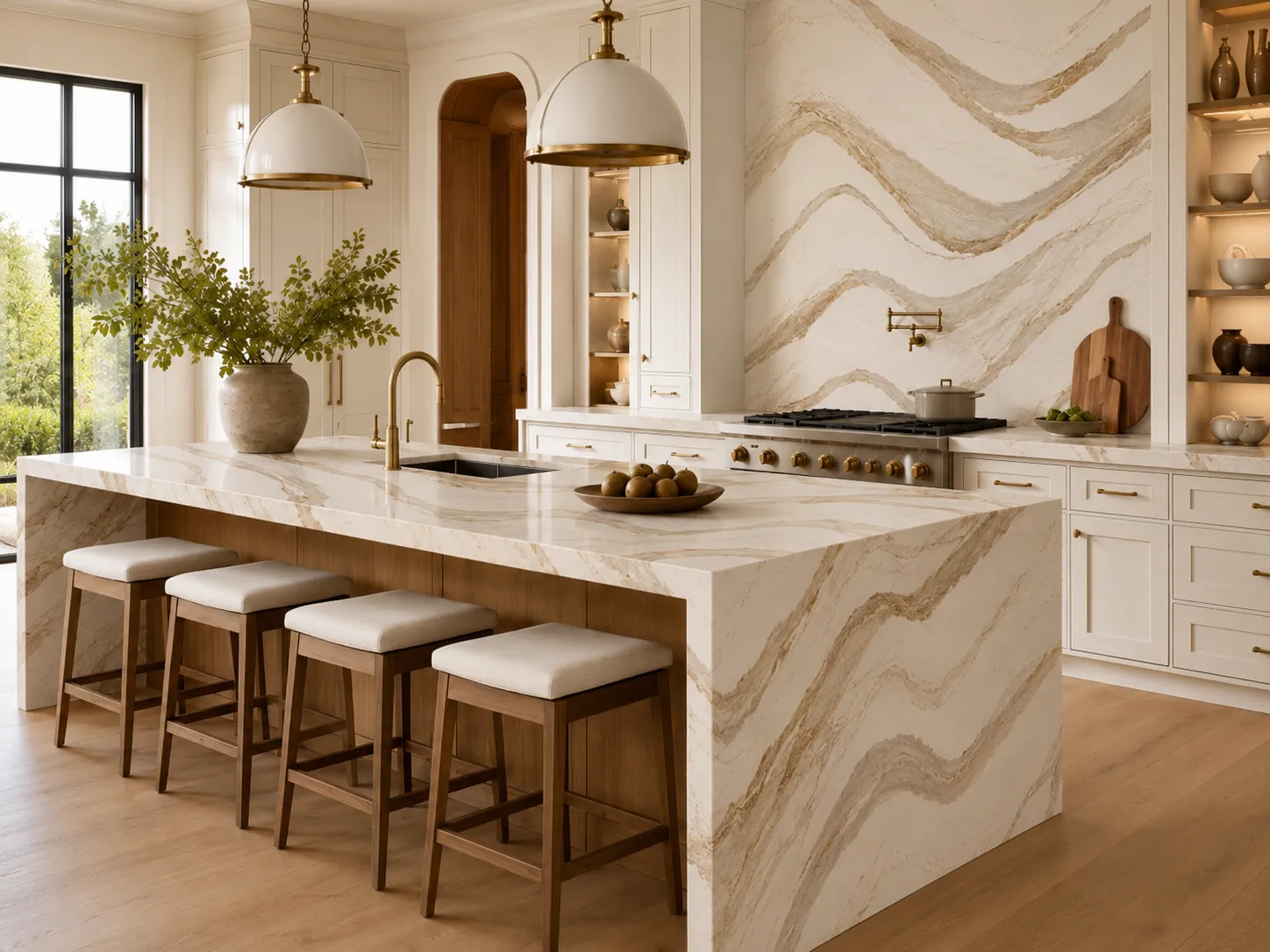
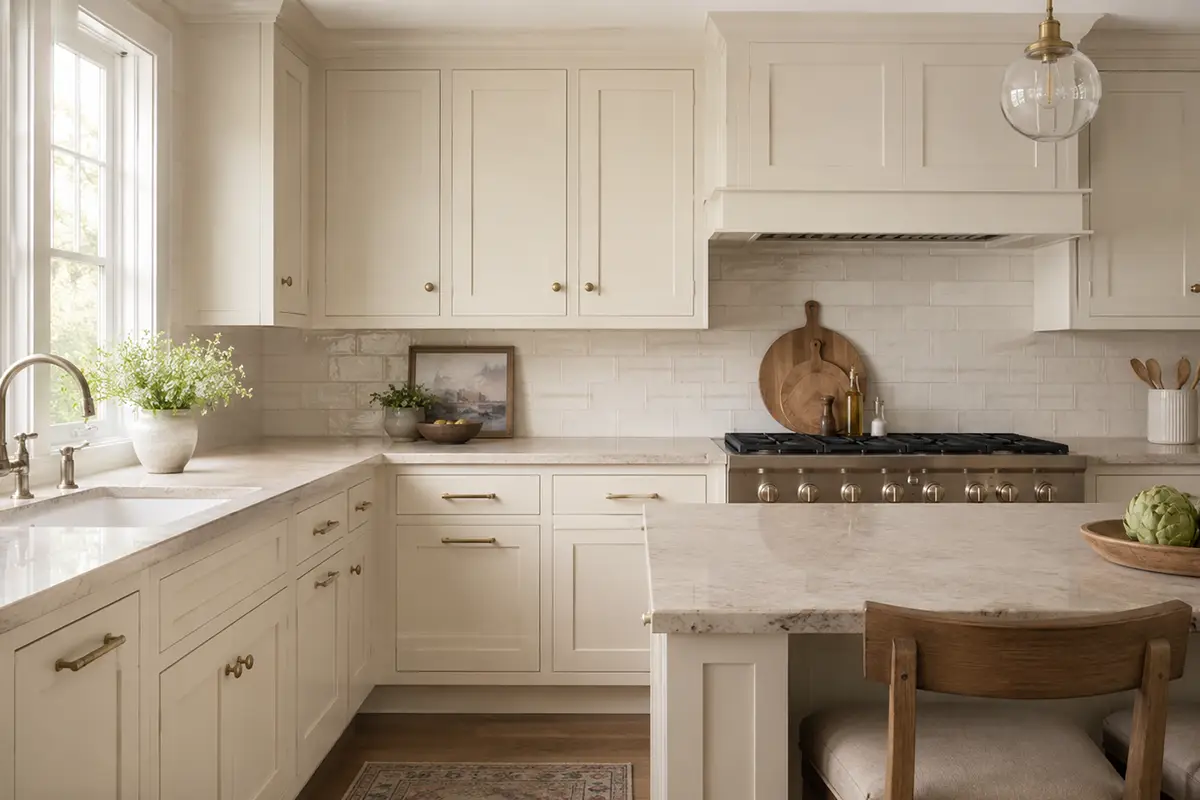
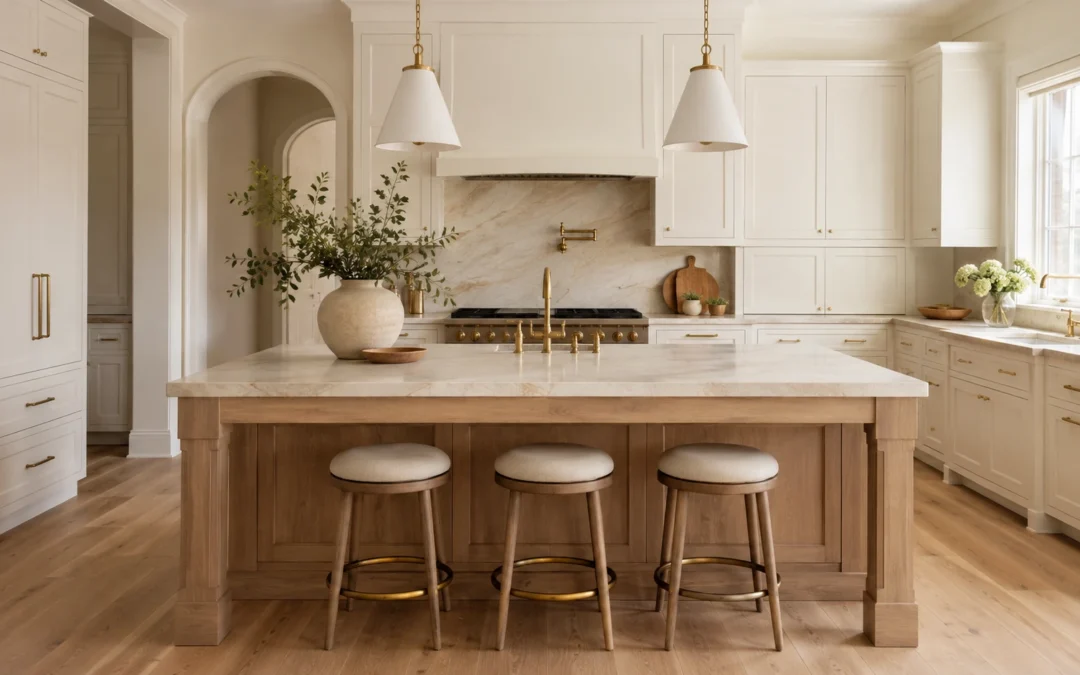
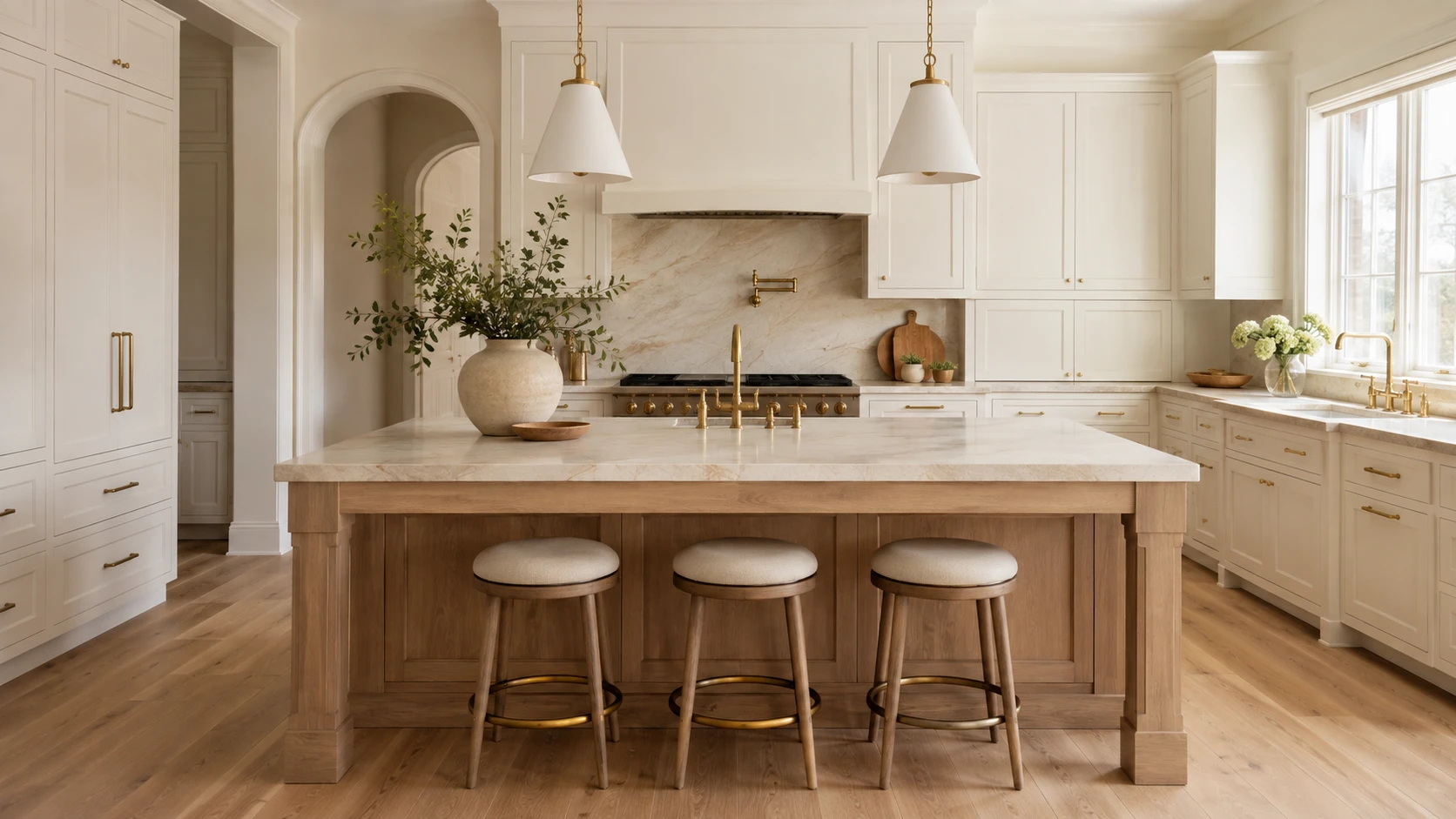
Warm off-white kitchen cabinets with a natural white oak island, creamy stone countertops, brass hardware, and light oak flooring.

Choosing a kitchen cabinet color can feel more permanent than almost any other design decision. Wall paint, lighting, and accessories can be replaced relatively easily, but cabinetry covers a large portion of the room and represents a significant investment.

The goal is not simply to choose the safest color or copy the latest kitchen trend. The goal is to select a finish that works with your home’s architecture, natural light, flooring, countertops, and overall atmosphere—so the kitchen continues to feel balanced and intentional years from now.

Before choosing your kitchen cabinetry, use the following principles to create a palette that feels current today but remains adaptable for the future.

What Current Kitchen Research Tells Us

According to the 2026 Houzz Kitchen Trends Study, wood became the most selected cabinet finish among renovating homeowners, narrowly moving ahead of white. Medium and light wood tones accounted for most wood selections, while off-white remained an important choice. Green also moved slightly ahead of gray.

The 2026 NKBA Kitchen Trends Report similarly points toward neutrals, greens, blues, natural materials, and wood grain. It also shows that homeowners and designers are increasingly using stronger colors on islands, backsplashes, and decorative features instead of applying them to every surface.

These findings do not mean that one color is guaranteed to remain timeless. They show a broader movement toward warmth, natural texture, and colors that feel connected to the rest of the home.

1. Start With the Permanent Materials

Do not begin with a cabinet paint swatch. Begin with the elements that will be the most expensive or difficult to replace:

  • Flooring
  • Countertops
  • Natural stone
  • Backsplash
  • Existing woodwork
  • Adjacent-room finishes
  • Large appliances that will remain

2. Understand Undertones

Two colors may both be called white, beige, gray, green, or blue but look completely different once installed. Common undertones include:

Yellow or cream

  • Pink or red
  • Green
  • Blue
  • Violet
  • Brown
  • Gray
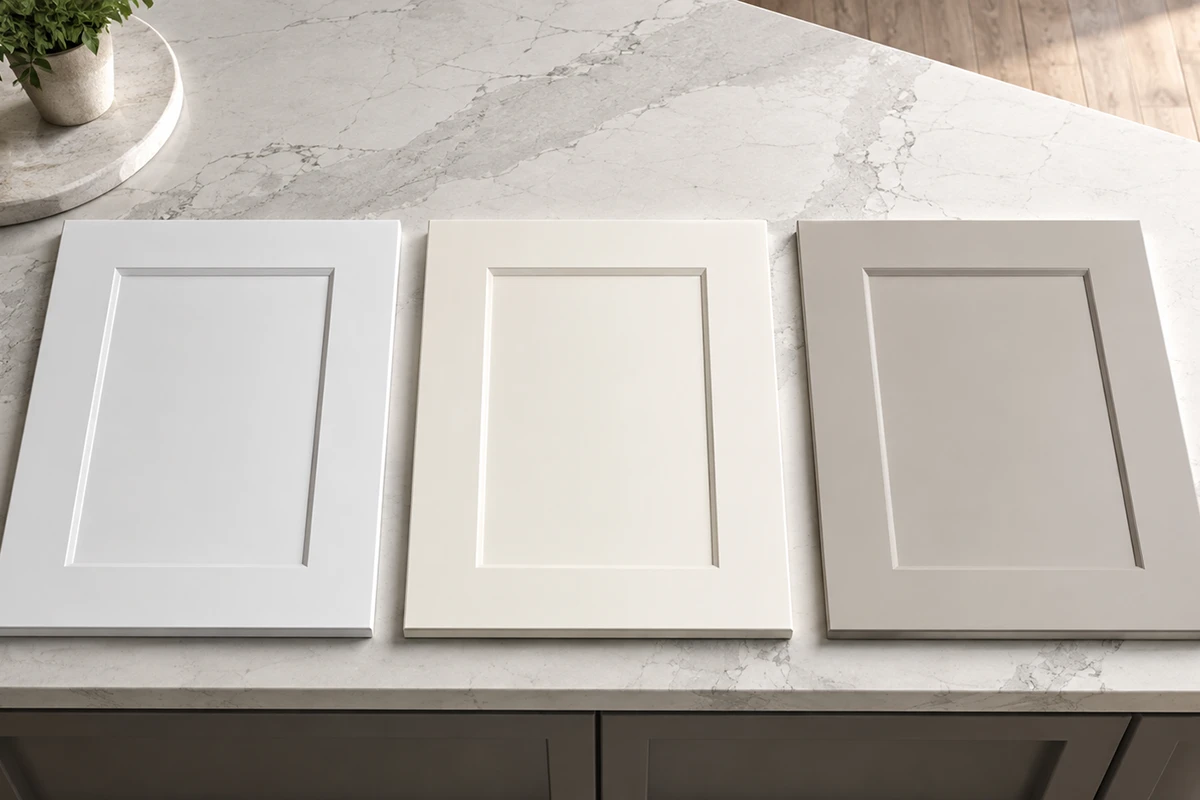
Cool white, warm white, and soft greige Shaker cabinet door samples displayed together on a light stone countertop.

3. Consider How You Want the Kitchen to Feel

Color psychology can be useful, but it should be treated as a guide rather than a strict formula.

A 2025 systematic review of 132 peer-reviewed studies found that people form recurring emotional associations with color. Lightness, saturation, and hue all influence those associations, but culture, personal experience, context, and surrounding materials also matter.

In a kitchen, these general impressions may help guide your selection:

Warm white and off-white

These colors can make a kitchen feel bright, gentle, and welcoming, especially when paired with warm flooring and natural materials.

Natural wood

Wood often creates a grounded, tactile, and organic atmosphere. The visible grain adds movement and character without requiring a strong painted color.
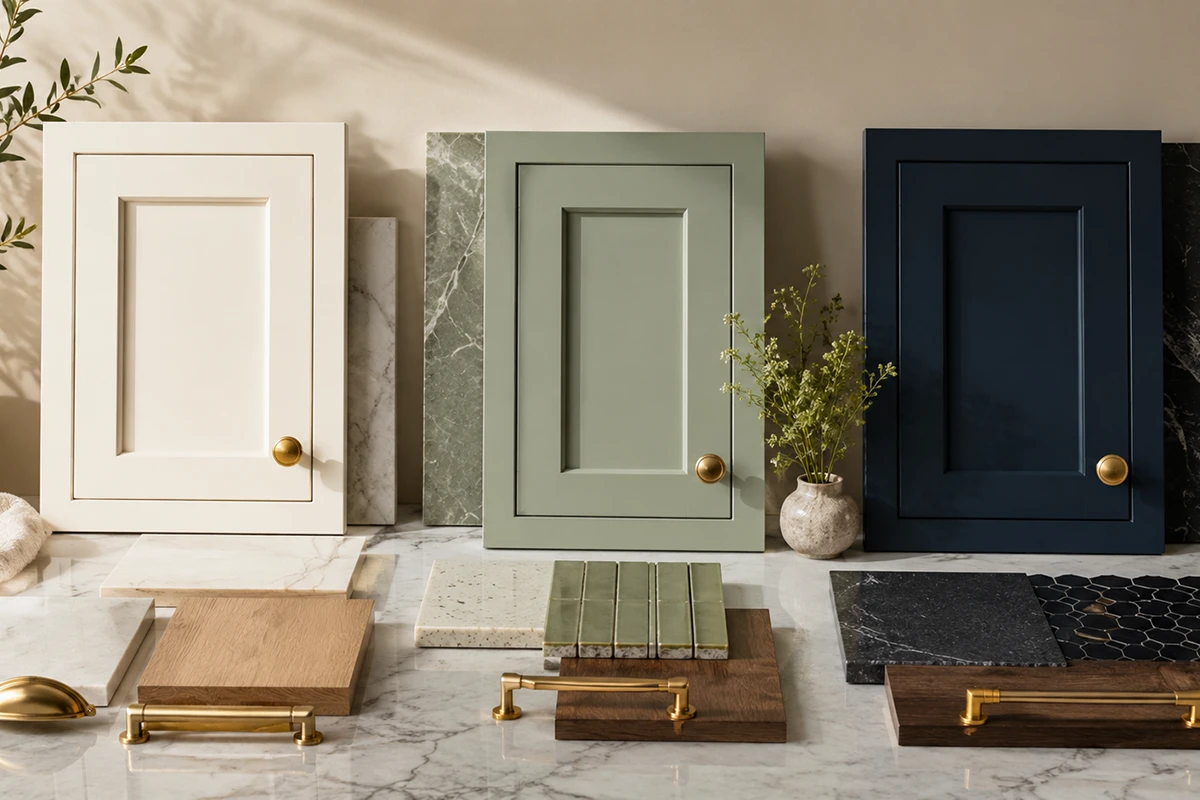
Warm white, muted sage green, and navy cabinet door samples coordinated with stone, tile, wood, and brass hardware.

Muted green

Sage, olive, and gray-green finishes can feel calm and connected to nature. A muted green usually adapts more easily than a highly saturated emerald or lime.

Blue and navy

Soft blue can feel relaxed and composed. Navy creates greater contrast, formality, and visual depth.

Taupe, mushroom, and greige

These shades can create a quiet, layered neutral palette without the sharpness of bright white or the coolness of traditional gray.

Burgundy and deep red

These colors feel warmer, richer, and more expressive. They may work best as a carefully coordinated statement rather than an automatic neutral.

Do not assume that every green will feel calming or every white will make a room feel larger. A bright, highly saturated green can feel energetic, while a gray-green sage may feel softer. The complete effect depends on lighting, surface area, saturation, and the materials around it.

Ask yourself:

How do I want this kitchen to feel during everyday life?

4. Choose a White That Works With the Home

White cabinetry can still be a long-lasting choice, but stark white is not always the most adaptable option.

Very bright or blue-white cabinetry may feel harsh in a room with:

    • Warm wood flooring
    • Creamy countertops
    • Limited natural light
    • Beige or warm-gray walls
    • Brass or bronze finishes

Softer alternatives include:

    • Warm white
    • Creamy white
    • Soft ivory
    • Off-white
    • Pale greige
    • Light mushroom

These finishes can keep the kitchen feeling bright while creating a softer relationship with wood, natural stone, and adjoining living spaces. Always compare the cabinet sample with the countertop. A cabinet may look warm white by itself but suddenly appear yellow, gray, or pink beside the chosen stone.

5. Treat Natural Wood as a Neutral

The final result depends on:

  • Wood species
  • Grain pattern
  • Stain color
  • Door profile
  • Hardware
  • Countertop
  • Backsplash
  • Overall architecture

White oak, walnut, maple, and other wood finishes can work in modern, organic, transitional, and classic kitchens.

For a design that can adapt over time, consider:

  • Natural or lightly stained wood
  • Light or medium wood tones
  • Low-sheen finishes
  • Simple Shaker or flat-panel doors
  • Stains that allow the grain to remain visible

The 2026 NKBA report identified wood grain as a growing cabinet direction and white oak as the leading wood species among surveyed professionals.

Avoid choosing an intense stain only because it is temporarily popular. A finish that respects the wood’s natural character is often easier to coordinate with future paint, hardware, and décor changes.
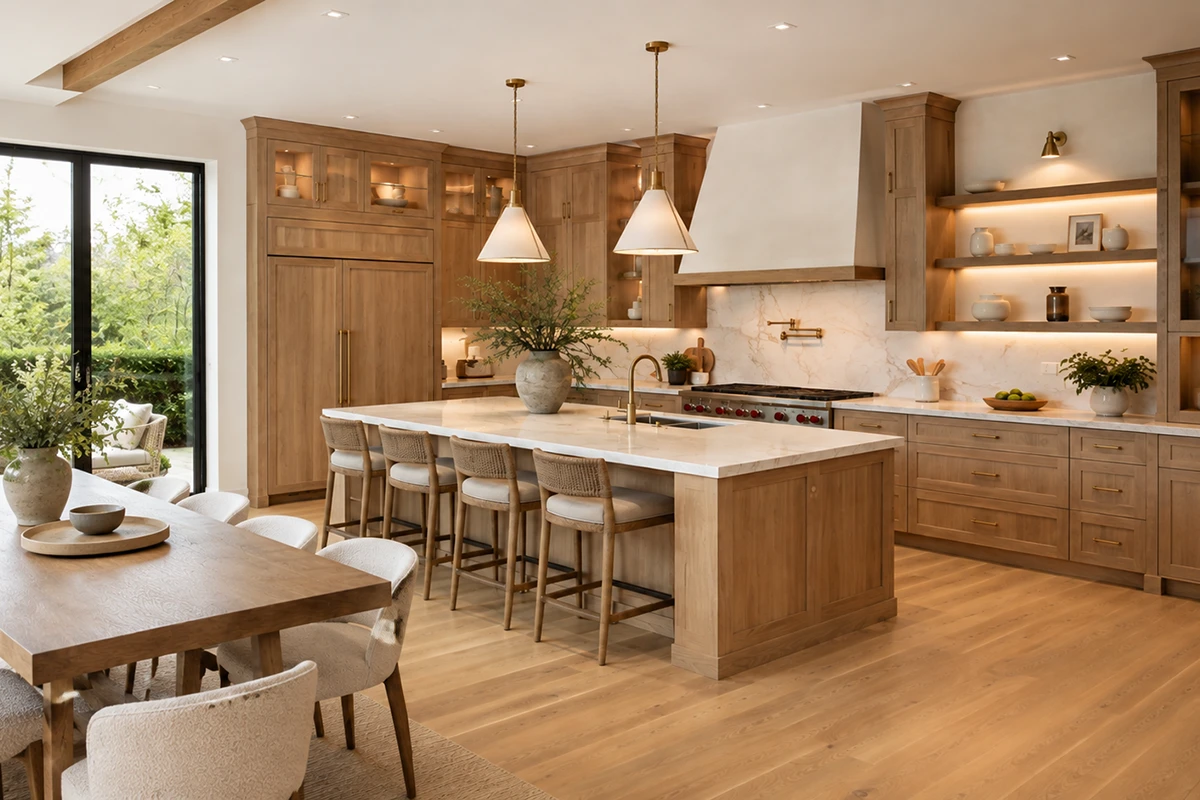
Close-up of light natural oak kitchen cabinets with subtle wood grain, creamy stone countertops, and brushed brass hardware.

6. Choose Grounded Colors Instead of Extremely Saturated Ones

Colorful cabinets can age beautifully when the shade is connected to natural materials and the architecture of the home.

Potentially adaptable colors include:

  • Muted sage
  • Deep olive
  • Soft blue-gray
  • Navy
  • Warm taupe
  • Mushroom
  • Deep burgundy

The difference is often in the saturation.
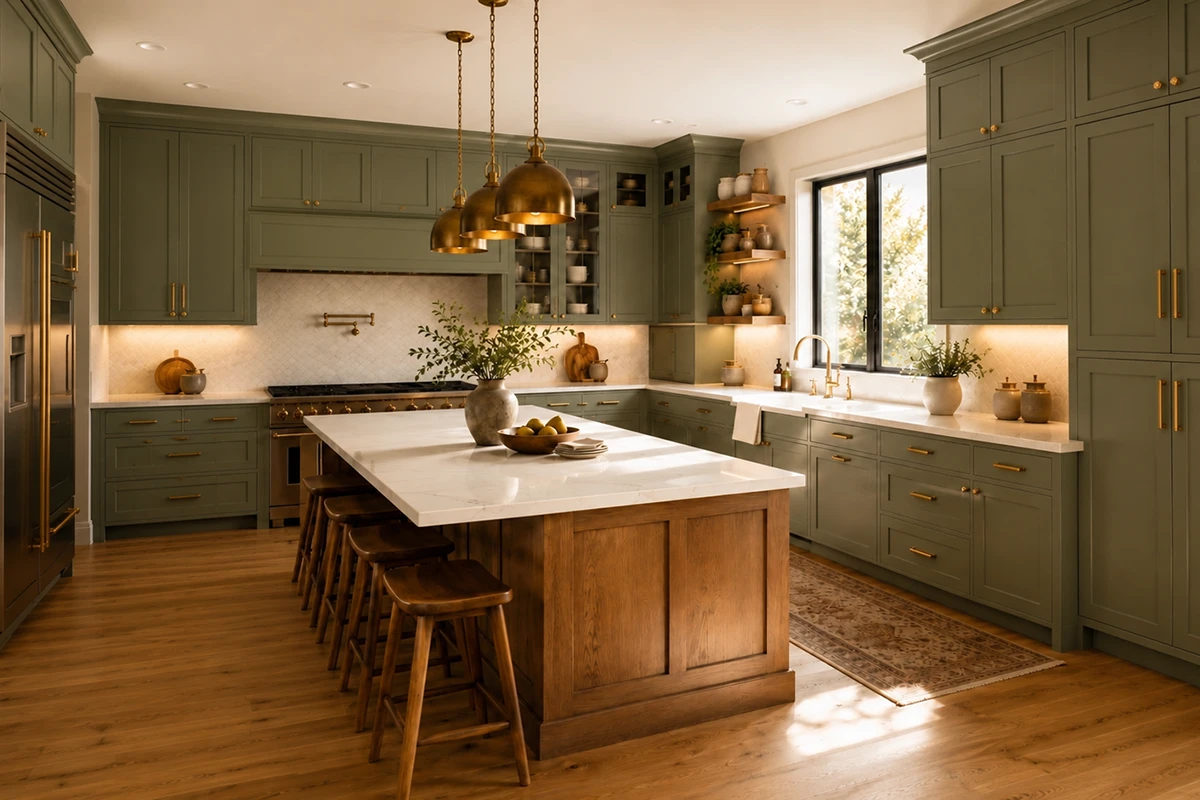
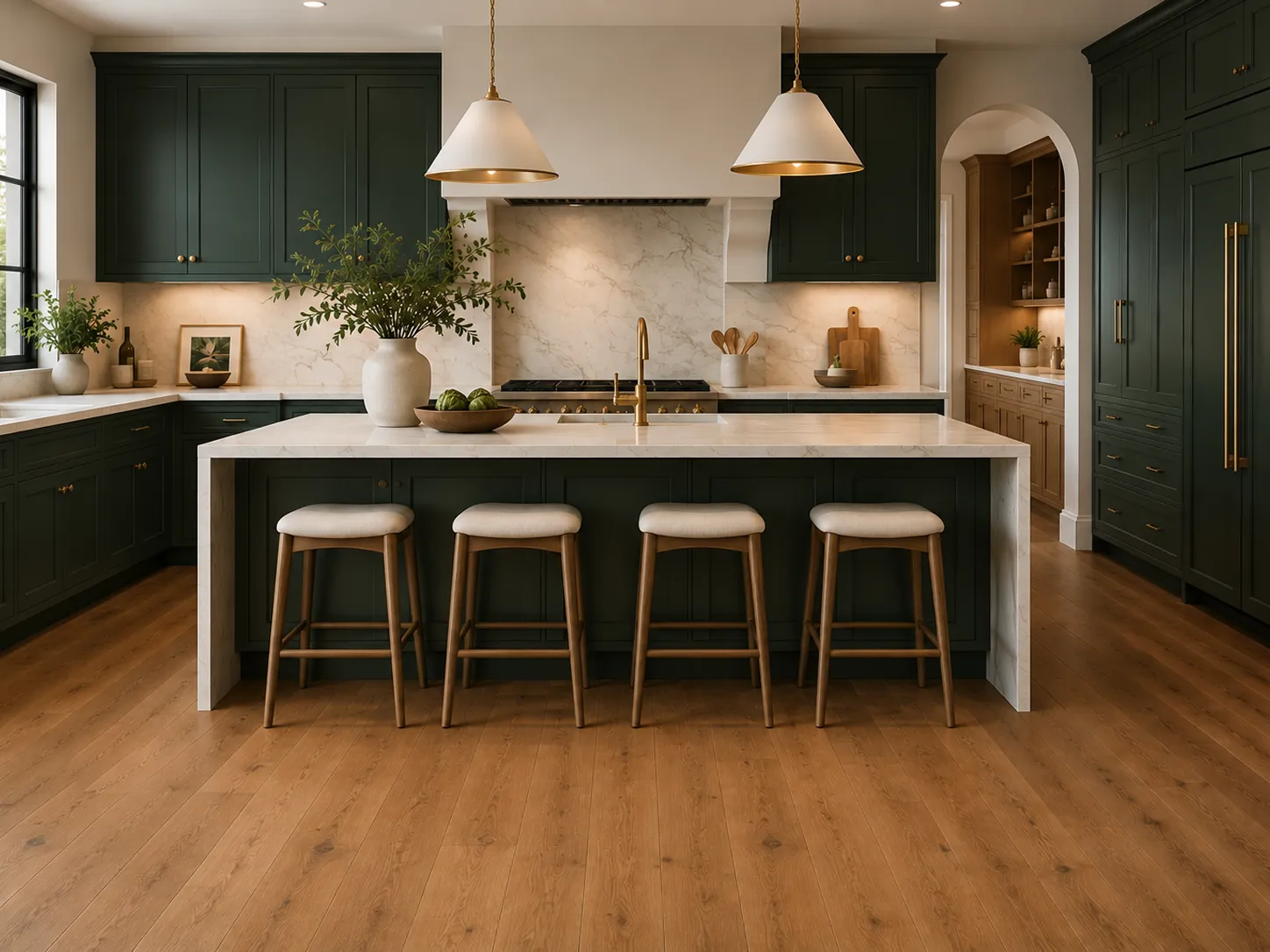
Timeless olive green Shaker kitchen cabinets with a natural wood island, white stone countertops, brass hardware, warm lighting, and oak flooring.

A gray-green sage may behave almost like a neutral. A bright, highly saturated green may dominate the entire room and limit future changes.

Before ordering colorful cabinetry, ask:

  • Does it coordinate with the flooring?
  • Does it appear in the countertop veining?
  • Does it work in both daylight and artificial light?
  • Can the hardware be changed later without disrupting the palette?
  • Would I still choose it if it were not currently trending online?

7. Use a Contrasting Island Strategically

A two-tone kitchen can feel custom and layered, but the island should relate to another element in the room.

Successful combinations may include:

  • Warm white cabinets with a natural oak island
  • Navy cabinets with a warm white island
  • Muted green cabinets with a light wood island
  • Off-white cabinets with a taupe island
  • Natural wood cabinets with a soft painted island

The contrasting color might connect with the floor, countertop veining, hardware, nearby furniture, or architectural details.

Current NKBA research suggests that islands are one of the leading locations for statement color, making them a practical way to introduce personality without applying a bold finish throughout the entire kitchen.

When developing a two-tone palette, treat the cabinets, island, flooring, countertops, and backsplash as one coordinated kitchen remodeling design, not as separate purchases.
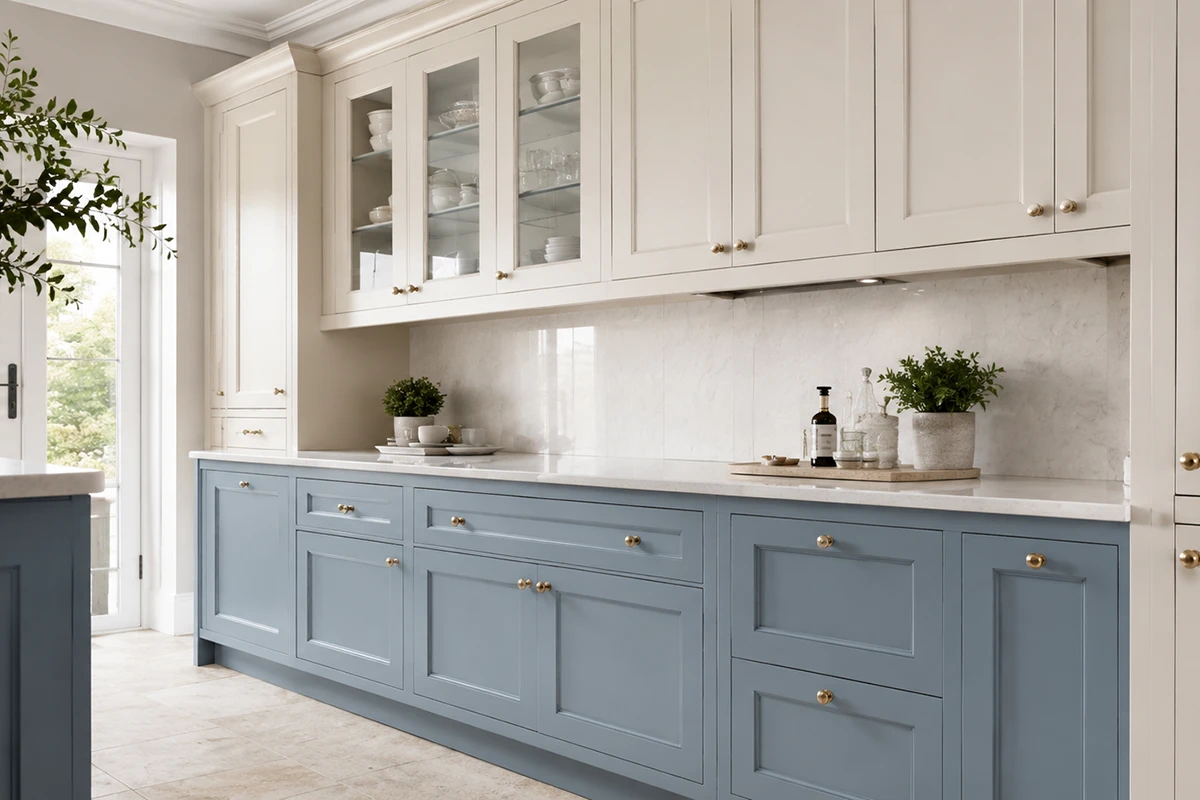
Timeless olive green Shaker kitchen cabinets with a natural wood island, white stone countertops, brass hardware, warm lighting, and oak flooring.

8. Test Large Samples in the Actual Lighting

Cabinet colors can change dramatically throughout the day. A finish may appear: 

  • Darker in a north-facing room
  • Warmer in afternoon sunlight
  • Greener beside warm wood
  • Bluer under cool LED bulbs
  • Flatter in a room with limited daylight
  • More intense across an entire wall than on a small sample

Whenever possible, review a full cabinet-door sample rather than a small paint chip.

Place it vertically, because cabinet doors will not be viewed flat on a table. Observe it in:

  • Morning daylight
  • Afternoon light
  • Evening light
  • Ceiling lighting
  • Pendant lighting
  • Under-cabinet lighting

Natural and task lighting are major considerations in current kitchen planning, so the cabinet finish should be evaluated under the lighting that will actually be used in the completed room.

During an interior design consultation, cabinet doors can be compared with stone, flooring, tile, paint, and hardware before the order is placed. Karpet King’s consultation service specifically includes color-palette development and coordination among these materials.

9. Think Beyond the Current Trend Cycle

Trends can provide inspiration, but they should not be the only reason behind a permanent design decision.

Ask yourself:

  • Does this color suit the age and architecture of the home?
  • Does it work with the permanent materials?
  • Would I still like it if I stopped seeing it on social media?
  • Can I refresh the kitchen later with different hardware or wall paint?
  • Does the color support the atmosphere I want?
  • Does it connect naturally with adjoining rooms?

A timeless kitchen does not have to be white, beige, or conservative. A navy, green, wood, or burgundy kitchen can remain beautiful when the color has a clear relationship with the rest of the design.

10. Consider the Material Beneath the Finish

The same color can appear different depending on whether it is applied to:

  • Solid wood
  • MDF
  • Wood veneer
  • Plywood
  • Another engineered material

Painted MDF may create a very smooth, consistent surface. Painted solid wood may retain subtle grain and may show fine movement at the joints over time.

Stained cabinetry behaves differently because the wood species affects how the stain is absorbed. The same stain may look warmer, darker, or more varied on oak, maple, cherry, or walnut.

Common Cabinet-Color Mistakes

Choosing from a small swatch

A small sample cannot show how a color will feel across an entire wall of cabinetry. Request the largest sample available.

Ignoring the flooring

Cabinets and floors occupy large visual areas. Conflicting undertones can make the entire kitchen feel disconnected.

Selecting the countertop afterward

Cabinetry and countertops should be developed together. Neither should become an afterthought.

Copying a kitchen with different lighting

A deep green kitchen shown in a large, sunny home may look very different in a smaller room with limited daylight.

Using too many competing finishes

Cabinets, island, flooring, stone, tile, wall paint, hardware, and lighting should not all compete for attention. Decide which element will lead the design.

Choosing a trend instead of a complete palette

A fashionable cabinet color does not guarantee a successful kitchen. Coordination is more important than popularity.

For broader project planning, read How to Plan a Kitchen Remodel Without Stress in the DMV Area.

Showroom Checklist: What to Bring

Bring the following items when comparing cabinet colors:

  • Flooring sample
  • Countertop or stone sample
  • Backsplash ideas
  • Photos of the kitchen in daylight
  • Photos of adjoining rooms
  • Approximate measurements
  • Inspiration images
  • Existing finishes that must remain
  • Appliance colors
  • Preferred hardware finishes

At the showroom:

  • View cabinet doors vertically
  • Compare warm and cool versions of the same color
  • Place the cabinet, countertop, flooring, and hardware together
  • Look at the samples under more than one light source
  • Ask about the cabinet material and finish
  • Ask whether touch-up products are available
  • Photograph the complete combination for later review

A cabinet color that remains beautiful for years is not necessarily the palest or safest option. It is the color that works with the home’s architecture, permanent materials, lighting, and the emotional atmosphere you want the kitchen to create.

Current research points toward natural wood, softened whites, grounded neutrals, greens, and blues. However, long-term satisfaction depends more on careful coordination than on choosing the most popular color of the year.

Compare real cabinet doors with your flooring, countertop, backsplash, and hardware before making the final decision. The goal is not to find one universally timeless color. It is to create a kitchen that feels personal, balanced, and adaptable.

Visit our Rockville showroom to compare cabinetry, countertops, flooring, tile, and hardware in person.

Book an interior design consultation at Karpet King Design Center in Rockville, Maryland.
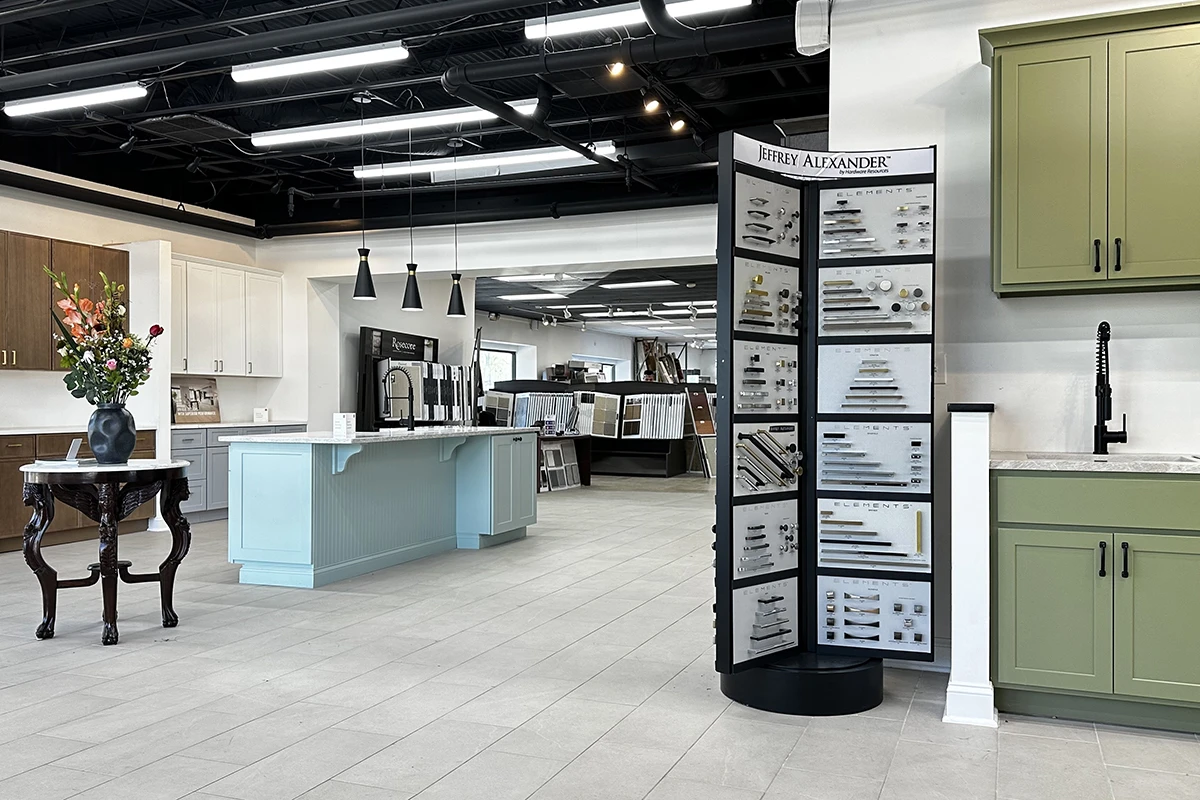
Kitchen cabinet showroom featuring white, blue, and sage green display cabinets, countertop samples, sinks, and a central hardware selection tower.

How to Choose Kitchen Cabinet Colors That Will Still Look Beautiful in 10 Years

How to Choose Kitchen Cabinet Colors That Will Still Look Beautiful in 10 Years Choosing a kitchen cabinet color can feel more permanent than almost any other design decision. Wall paint, lighting, and accessories can be replaced relatively easily, but cabinetry…

Shaker vs. Flat-Panel Cabinets: Which Style Is Right for Your Kitchen?

Shaker vs. Flat-Panel Cabinets: Which Style Is Right for Your Kitchen? Choosing between Shaker cabinets vs. flat-panel cabinets is one of the most important visual decisions in a kitchen remodel. Cabinet doors cover a large portion of the room, so their profile…

Shaker vs. Flat-Panel Cabinets: Which Style Is Right for Your Kitchen?

Shaker vs. Flat-Panel Cabinets: Which Style Is Right for Your Kitchen?

Shaker vs. Flat-Panel Cabinets: Which Style Is Right for Your Kitchen?

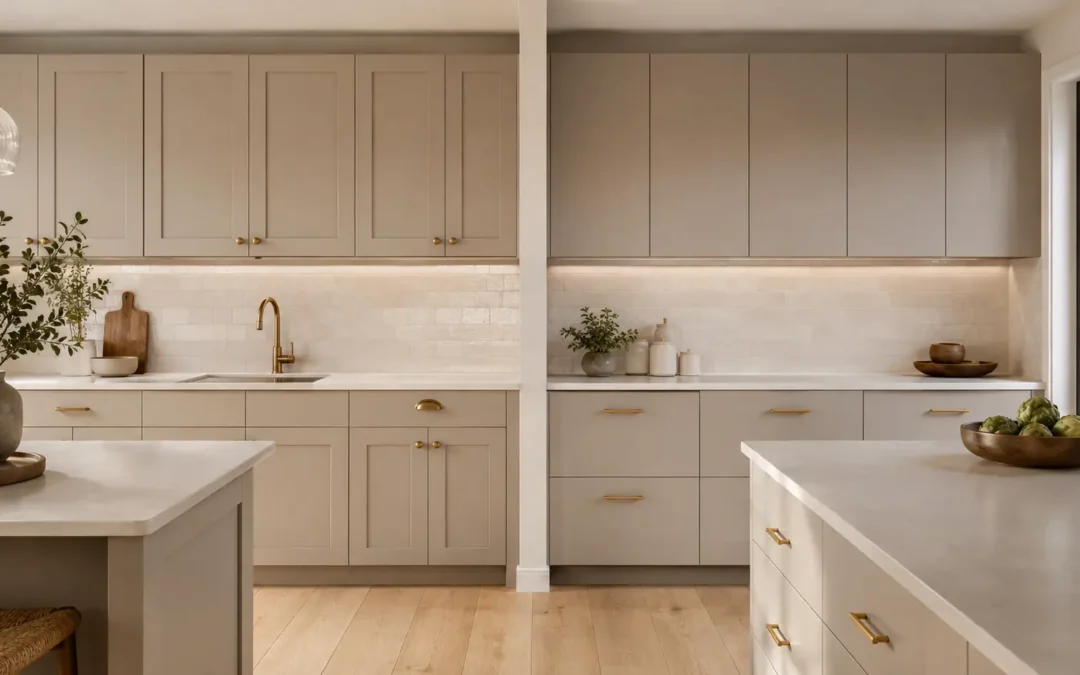
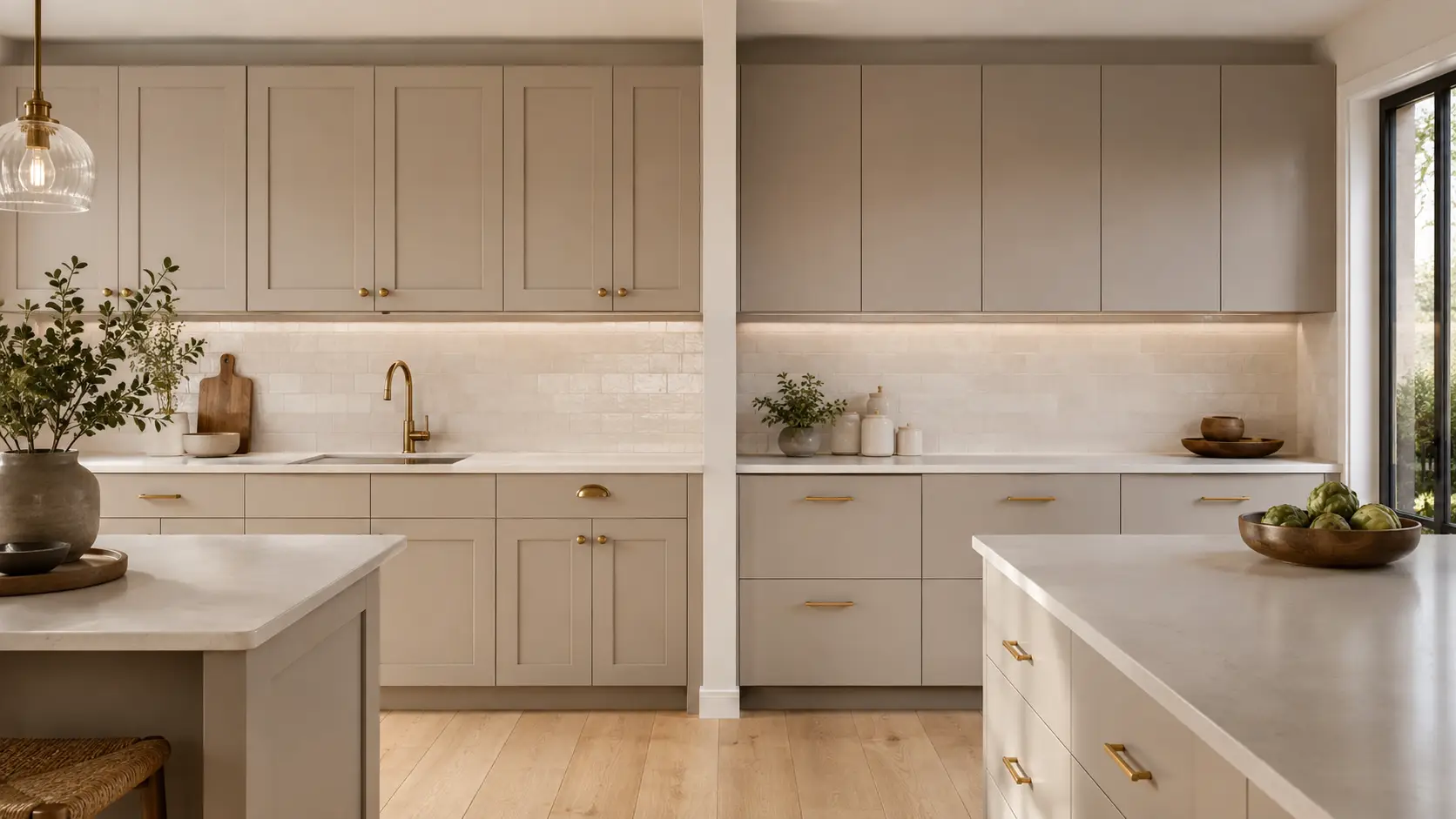
Side-by-side kitchen comparison showing slim Shaker cabinets and flat-panel cabinets in the same warm neutral finish.

Choosing between Shaker cabinets vs. flat-panel cabinets is one of the most important visual decisions in a kitchen remodel. Cabinet doors cover a large portion of the room, so their profile affects the kitchen’s character, perceived size, maintenance needs, and relationship with the rest of the home.

Shaker cabinets introduce subtle framing and architectural depth. Flat-panel cabinets create a smoother, more continuous appearance. Neither is automatically more timeless or higher quality, the right option depends on your architecture, lifestyle, materials, and preferred level of visual detail.

Before selecting your kitchen cabinetry, compare how each door style will function throughout the entire room, not only how one sample looks in isolation.

What Current Kitchen Research Shows

Shaker remains the most widely selected cabinet-door style among renovating homeowners. The 2025 U.S. Houzz Kitchen Trends Study found that 61% of homeowners chose Shaker-style doors, compared with 22% who selected flat-panel doors and 12% who selected raised-panel designs.

At the same time, flat-panel cabinetry is gaining attention in forward-looking kitchen design. The NKBA’s 2026 Kitchen Trends Report found that 69% of surveyed professionals identified flat slab cabinet doors as a feature expected to gain popularity, alongside minimalist layouts and integrated appliances.

Together, these findings suggest that Shaker remains the established favorite, while flat-panel cabinetry is an increasingly important choice for contemporary and visually quiet kitchens.

First, Understand the Difference

A Shaker-style door has a simple rectangular frame surrounding a recessed center panel. It provides definition without the carving or ornamentation found on many traditional raised-panel doors.

A flat-panel, or slab, door has a smooth front with no raised or recessed center panel. MasterBrand distinguishes the two by describing Shaker doors as simple recessed-panel designs and slab doors as flat surfaces that are neither raised nor recessed.

The phrase flat panel can occasionally cause confusion because some manufacturers also use it to describe the flat center panel inside a framed door. When speaking with a showroom consultant, clarify whether you mean:

  • A five-piece recessed-panel Shaker door
  • A completely smooth slab door

Option A: Shaker Cabinets

What Do Shaker Cabinets Look Like?

Shaker cabinets feature rails and stiles forming a rectangular frame around a recessed center panel. The design is structured but restrained, making it less ornate than traditional cabinetry and more detailed than a slab front.

Not all Shaker doors look the same. The width of the frame has a significant effect:

  • Standard Shaker: wider rails and stiles with a classic, substantial appearance
  • Slim Shaker: narrower framing with a cleaner, more contemporary character
  • Shaker with slab drawers: framed doors paired with smooth drawer fronts
  • Five-piece drawer Shaker: matching framed profiles on doors and drawers

Always review the exact door style on several cabinet sizes before ordering.

Transitional kitchen with warm Shaker cabinets, recessed panel doors, stone countertops, and understated metal hardware.

Why Shaker Cabinets Remain Popular

They adapt to many design styles

Shaker cabinets can work in:

  • Transitional kitchens
  • Classic interiors
  • Modern farmhouse homes
  • Organic-modern kitchens
  • Coastal spaces
  • Updated traditional homes

Their appearance changes according to the finish and surrounding materials. Warm white Shaker doors can feel classic, while slim white-oak Shaker cabinets can feel clean and contemporary.

They add architectural depth

The recessed panel creates subtle shadow lines across the cabinetry. This helps define large cabinet walls and adds structure without requiring decorative molding or carving.

Shaker doors can be particularly effective when paired with:

  • Quiet countertops
  • Simple backsplashes
  • Paneled appliances
  • Traditional trim
  • Furniture-style islands
  • Glass-front accent cabinets
They offer broad hardware flexibility

Shaker cabinets coordinate easily with many hardware styles:

  • Traditional knobs
  • Cup pulls
  • Short bar pulls
  • Long contemporary pulls
  • Brass, bronze, nickel, or black finishes

Changing the hardware in the future can refresh the kitchen without replacing the cabinetry.

They bridge traditional and modern design

A standard Shaker profile tends to feel more classic, while a slim Shaker profile can create a cleaner and more architectural appearance.

This makes Shaker useful for homeowners who want an updated kitchen that still feels connected to the age or architecture of the home.

Potential Drawbacks of Shaker Cabinets

They require more detailed cleaning

The inside edges surrounding the recessed panel can collect dust, crumbs, or cooking residue. Routine cleaning is still straightforward, but it takes slightly more attention than wiping a completely smooth slab door.

Wide frames can create visual busyness

In a kitchen with many narrow doors and drawers, Shaker framing introduces repeated horizontal and vertical lines.

This can feel crowded when combined with:

  • Highly patterned countertops
  • Decorative backsplash tile
  • Elaborate hardware
  • Extensive molding
  • Many small cabinet sections

A slim Shaker profile or slab drawer front can reduce that visual weight.

Door proportions matter

A frame that looks elegant on a tall pantry door may feel compressed on a narrow cabinet or shallow drawer.

Ask to see the chosen profile on:

  • Small drawer fronts
  • Wide drawers
  • Narrow wall cabinets
  • Tall pantry cabinets
  • Appliance panels

Shaker Cabinets Are Best For

Shaker may be the stronger choice when you want:

  • Architectural detail without ornament
  • A transitional or classic foundation
  • Flexibility with hardware and finishes
  • A style that works with changing décor
  • Broad appeal for future resale
  • A balance between traditional and contemporary design

Option B: Flat-Panel Cabinets

What Do Flat-Panel Cabinets Look Like?

Flat-panel cabinets use smooth slab doors without a separate surrounding frame or recessed center.

Because the surface is uninterrupted, the eye focuses more strongly on:

  • Cabinet proportions
  • Alignment
  • Wood grain
  • Finish quality
  • Door spacing
  • Hardware placement
  • Material texture

Flat-panel doors are often paired with frameless cabinet construction to create tighter reveals and a more continuous façade.

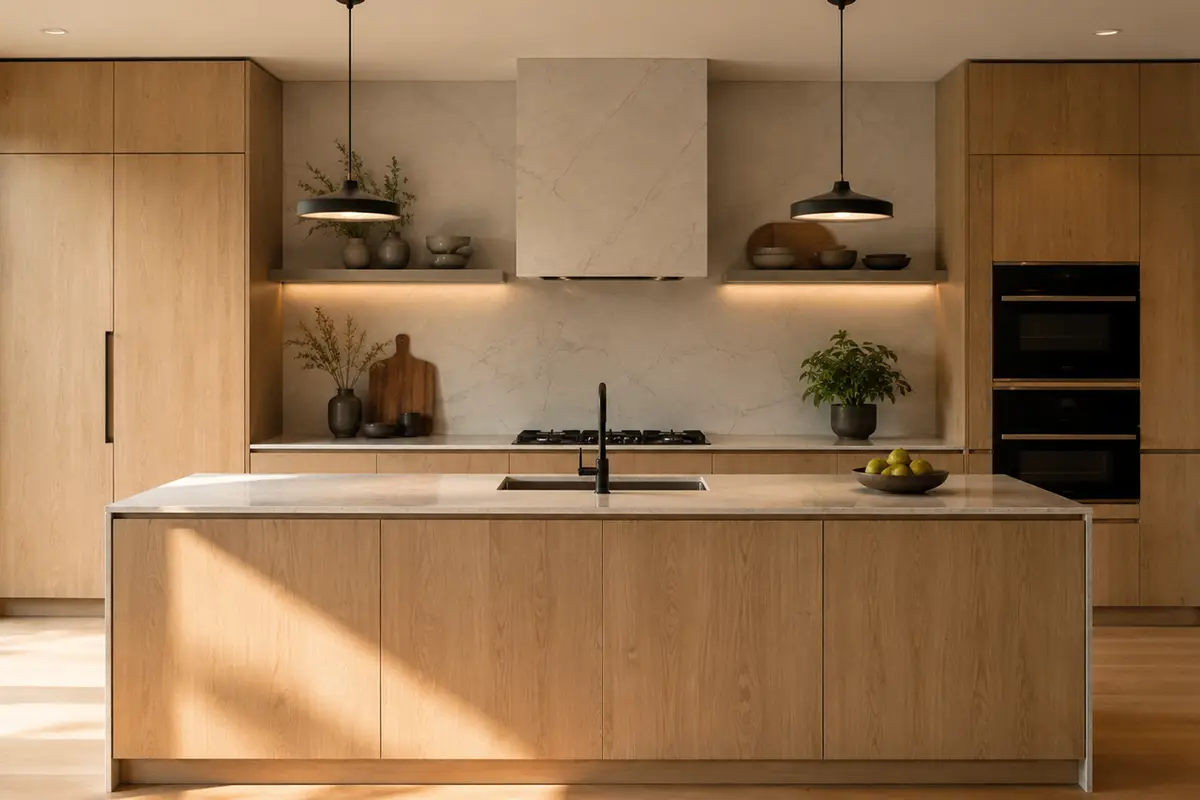
Modern kitchen with smooth flat-panel cabinets, natural wood grain, minimal hardware, and integrated appliances.

Why Homeowners Choose Flat-Panel Cabinets

They create a cleaner visual field

Flat-panel doors reduce the number of lines across the room. This can make cabinetry feel quieter, more integrated, and more architectural.

They are especially effective when the kitchen already contains a strong focal point, such as:

  • Dramatic stone
  • A full-height backsplash
  • Sculptural lighting
  • A statement island
  • Strong wood grain
  • Large architectural windows
They showcase materials

A broad slab surface is ideal for highlighting:

  • Natural oak or walnut veneer
  • Sequence-matched wood grain
  • Matte paint
  • Textured laminate
  • Acrylic
  • High-gloss finishes
  • Engineered wood surfaces

MasterBrand notes that contemporary cabinet materials such as veneer, laminate, and acrylic can offer consistent color, grain, and finish options.

With natural wood slab doors, the grain itself becomes a primary design feature.

They are generally quicker to wipe

A flat surface has no recessed corners or frame edges. This can make routine cleaning simpler.

However, the finish still matters. Dark matte doors may reveal fingerprints, while glossy doors may show reflections and smudges more readily.

They work well in compact kitchens

Flat-panel fronts can reduce repeated visual interruptions in a small room. They may help a compact kitchen feel calmer, especially when paired with a light or medium finish and consistent hardware.

They do not automatically make the room larger, though. Lighting, contrast, cabinet height, and layout remain equally important.

Potential Drawbacks of Flat-Panel Cabinets

Alignment must be precise

Simple cabinet fronts make inconsistencies easier to notice. Uneven gaps, misaligned drawers, or poorly placed fillers can stand out more clearly than they might on a detailed door.

Professional measurement and installation are particularly important.

Some combinations can feel cold

Flat-panel cabinets are not inherently cold, but an all-white glossy kitchen with cool lighting and minimal texture may feel clinical.

To create warmth, consider pairing slab doors with:

  • Natural wood
  • Warm stone
  • Brass or bronze hardware
  • Textured tile
  • Soft lighting
  • Handmade accessories
  • Low-sheen finishes
Edge quality becomes more visible

Because slab doors do not have a frame, their edges are an important part of the finished appearance.

Ask:

  • Is the door solid wood, MDF, veneer, laminate, or acrylic?
  • How are the edges finished?
  • Is edge banding visible?
  • Can grain be matched across adjoining fronts?
  • Is the finish repairable?
  • Are replacement doors available?
Handleless systems require planning

Flat-panel kitchens are often shown without visible hardware, but handleless cabinetry may require:

  • Integrated channels
  • Finger pulls
  • Push-to-open mechanisms
  • Recessed rails
  • Additional appliance coordination

Test the system in person. A minimal appearance is not useful if the doors feel uncomfortable to open every day.

Flat-Panel Cabinets Are Best For

Flat-panel cabinetry may suit:

  • Contemporary kitchens
  • Minimal interiors
  • Mid-century-inspired homes
  • Modern open-concept spaces
  • Small kitchens needing less visual interruption
  • Natural wood designs where grain is the focal point
  • Homeowners who prioritize quick surface cleaning
  • Projects with integrated appliances and precise architectural lines

Shaker vs. Flat-Panel Cabinets: Side-by-Side Comparison

Comparing cabinet doors under the same lighting makes differences in profile, material, and visual weight easier to see.

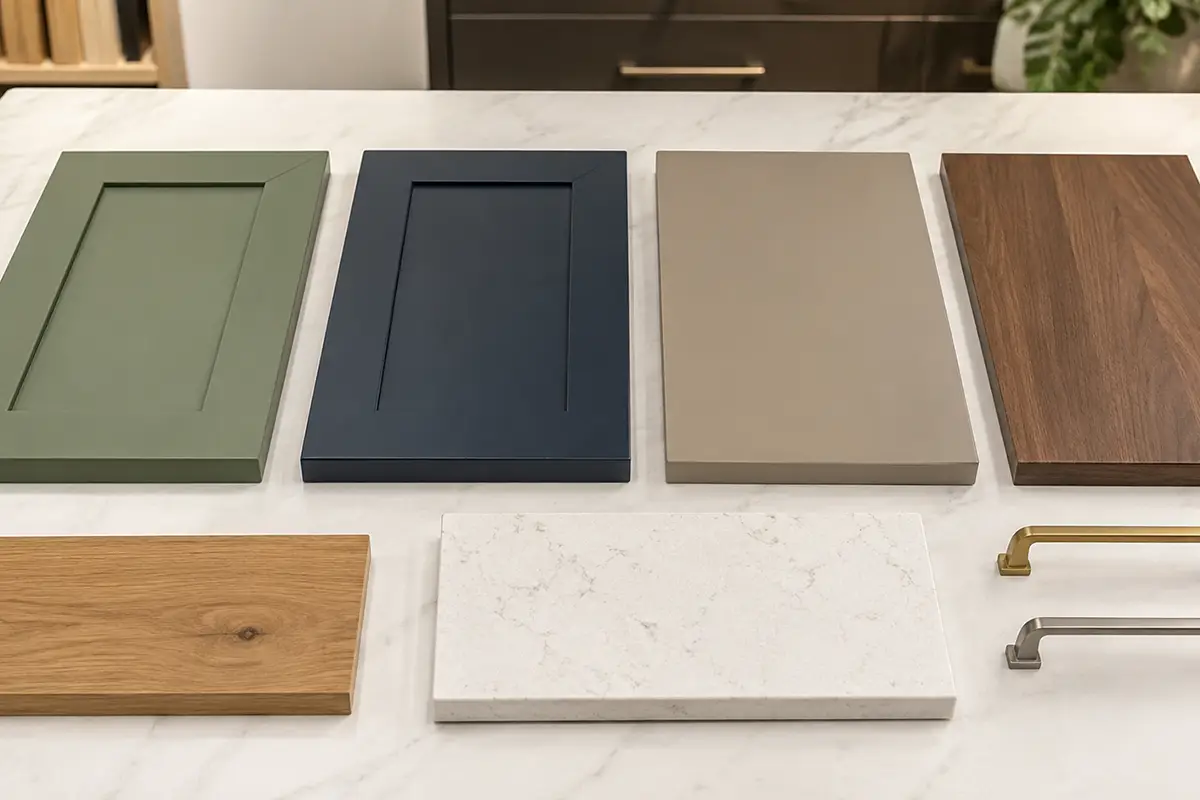
Standard Shaker, slim Shaker, painted slab, and wood flat-panel cabinet samples displayed with stone and hardware.


Consideration Shaker Cabinets Flat-Panel Cabinets
Appearance Framed and dimensional Smooth and uninterrupted
Typical direction Transitional, classic, farmhouse Modern, contemporary, minimal
Visual detail More shadow lines and structure Fewer lines and less interruption
Cleaning Frame edges require more attention Smooth fronts are generally quicker to wipe
Material emphasis Highlights profile and craftsmanship Highlights color, grain, and finish
Hardware Works with traditional or modern hardware Often paired with minimal or integrated pulls
Small kitchens Slim Shaker can work well Creates a quieter façade
Installation Alignment still matters Small alignment issues may be more visible
Natural wood Adds depth and visible construction Allows grain to become the main feature
Style flexibility Broad and highly adaptable Strongly shaped by finish and material
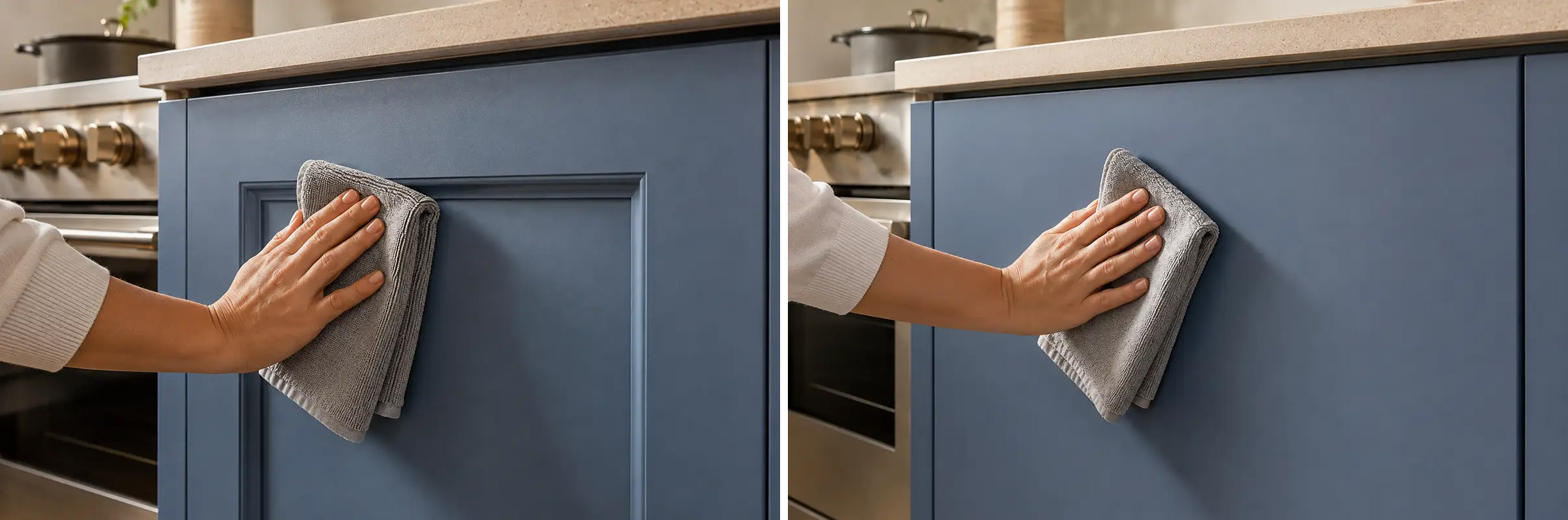
Comparison of cleaning a smooth flat-panel cabinet beside a framed Shaker cabinet door in a residential kitchen.

For a Busy Family Kitchen

Either style can work, but finish selection may matter more than the door profile.

Consider:

  • A durable low-sheen finish
  • Medium or softened colors
  • Easy-to-grasp hardware
  • Full-extension drawers
  • Soft-close hinges
  • Manufacturer-approved cleaning products

Flat-panel fronts may be faster to wipe, but a very dark matte slab can show fingerprints more easily than a medium-tone Shaker door.

For a Transitional Home

Shaker is often the most natural fit because it connects updated materials with traditional architectural details.

Consider:

  • Standard or slim Shaker doors
  • Warm white, mushroom, sage, or natural wood
  • Simple brass, nickel, or black hardware
  • Quiet stone
  • Restrained backsplash patterns

For a Modern Home

Flat-panel cabinets typically support contemporary architecture more naturally.

Consider:

  • Frameless cabinet construction
  • Full-overlay slab doors
  • Natural oak or walnut
  • Matte painted finishes
  • Integrated appliances
  • Minimal pulls
  • Carefully aligned horizontal and vertical lines

The NKBA’s 2026 report supports this direction, identifying minimalism, slab cabinet doors, integrated appliances, and solid-surface backsplashes as features expected to grow.

For a Homeowner Seeking a Timeless Kitchen

Shaker has the stronger historical association with classic American cabinetry and currently has the broadest homeowner adoption.

However, flat-panel cabinets can also age beautifully when they use:

  • Natural materials
  • Warm colors
  • Thoughtful proportions
  • Quality hardware
  • Precise installation
  • Restrained detailing

A trend-heavy finish is more likely to date a kitchen than the slab door itself.

For a Small Kitchen

Flat-panel fronts may reduce visual repetition, especially in a light or medium tone.

A slim Shaker door can provide a similar sense of simplicity while retaining subtle architectural depth.

Good options for compact kitchens include:

  • Light oak
  • Warm white
  • Soft mushroom
  • Muted blue-gray
  • Pale sage

For Natural Wood Cabinetry

Choose Shaker when you want visible structure and furniture-like craftsmanship.

Choose flat-panel when you want uninterrupted grain to become the central design feature.

For slab doors, ask whether the veneer can be sequence-matched across nearby doors and drawers.

For a Home With Traditional Architecture

Shaker cabinetry often connects more naturally with:

  • Crown molding
  • Arched openings
  • Paneled walls
  • Traditional window trim
  • Historic architecture

Flat-panel cabinetry can still work, but materials such as warm wood, natural stone, and aged metal can help bridge the contrast between contemporary cabinets and traditional surroundings.

Can You Mix Shaker and Flat-Panel Cabinets?

Yes. The combination should feel intentional rather than accidental.

Possible approaches include:

  • Shaker perimeter cabinets with a slab-front island
  • Shaker doors with slab drawer fronts
  • Flat-panel cabinetry with one framed furniture-style section
  • Slim Shaker upper cabinets with slab base drawers
  • Shaker pantry cabinets with a flat-panel beverage center

When combining profiles, keep at least two elements consistent:

  • Cabinet color
  • Finish
  • Hardware
  • Wood species
  • Countertop
  • Door proportions

Avoid mixing multiple door styles, multiple cabinet colors, several metals, dramatic stone, and patterned tile at the same time. Establish one clear focal point.

Common Cabinet-Style Mistakes

Yes. The combination should feel intentional rather than accidental.

Possible approaches include:

  • Shaker perimeter cabinets with a slab-front island
  • Shaker doors with slab drawer fronts
  • Flat-panel cabinetry with one framed furniture-style section
  • Slim Shaker upper cabinets with slab base drawers
  • Shaker pantry cabinets with a flat-panel beverage center

When combining profiles, keep at least two elements consistent:

  • Cabinet color
  • Finish
  • Hardware
  • Wood species
  • Countertop
  • Door proportions

Avoid mixing multiple door styles, multiple cabinet colors, several metals, dramatic stone, and patterned tile at the same time. Establish one clear focal point.

Showroom Checklist

Bring the following when comparing cabinet styles:

  • Kitchen measurements
  • Photos of the room
  • Flooring sample
  • Countertop sample
  • Backsplash ideas
  • Appliance finishes
  • Hardware preferences
  • Inspiration images
  • Photos of adjoining rooms
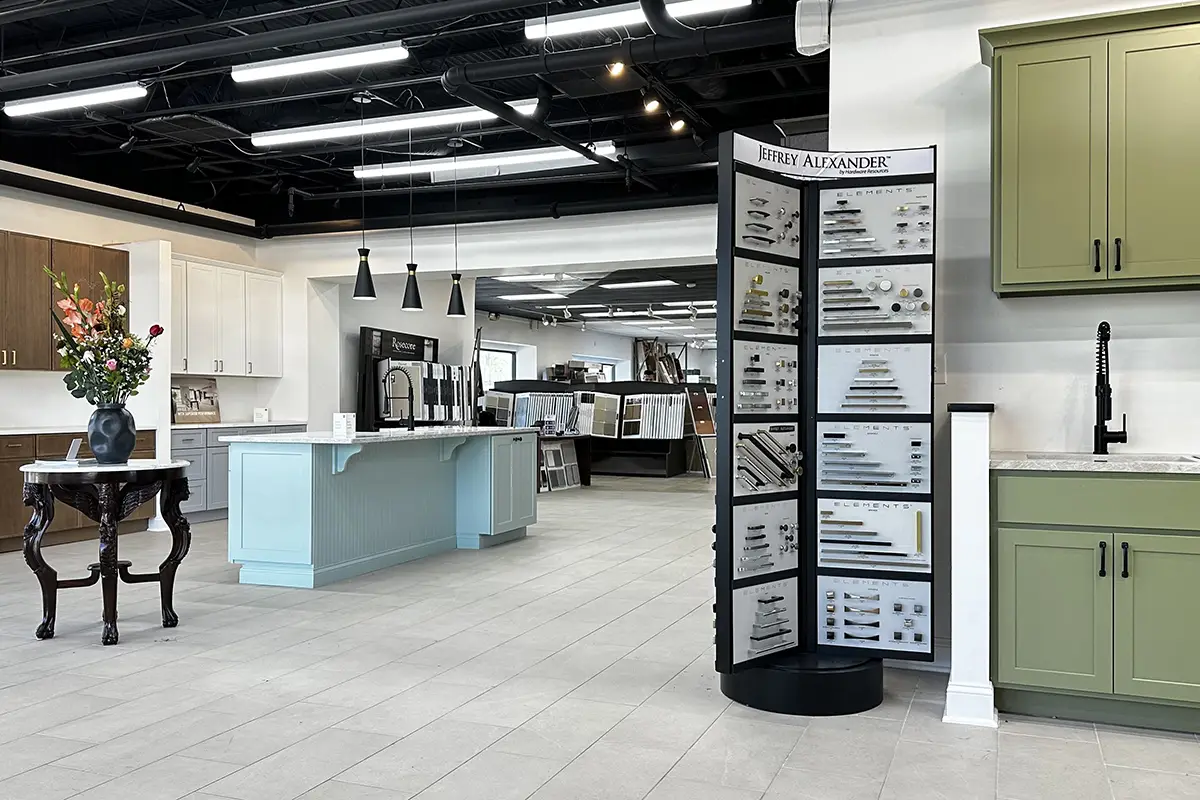
Kitchen cabinet displays and material samples inside Karpet King Design Center’s Rockville showroom.

Ask to compare:

  • Standard Shaker
  • Slim Shaker
  • Painted Shaker
  • Stained-wood Shaker
  • Painted slab
  • Wood-grain slab
  • Matte and gloss finishes
  • Framed and frameless construction
  • Slab and five-piece drawer fronts

Questions to ask:

  • What material is used for the door?
  • What material is used for the center panel?
  • How wide are the Shaker rails and stiles?
  • Is the drawer front slab or five-piece?
  • Is the cabinet framed or frameless?
  • Is the door full overlay, partial overlay, or inset?
  • How are slab-door edges finished?
  • Are touch-up products available?
  • Which cleaning products are approved?
  • What does the warranty cover?

During an interior design consultation, cabinet-door samples can be compared with countertops, flooring, tile, paint, and hardware before the order is finalized.

Final Recommendation

Choose Shaker cabinets when you want:

  • Subtle architectural detail
  • Broad design flexibility
  • A transitional or classic foundation
  • Compatibility with many hardware styles
  • A cabinet profile with wide homeowner appeal 

Choose flat-panel cabinets when you want:

  • A quieter visual surface
  • Clean architectural lines
  • A contemporary or minimal direction
  • Greater emphasis on wood grain or finish
  • Smooth fronts for easier routine wiping

When you appreciate both styles, slim Shaker cabinetry can provide an effective middle ground. It retains the framed profile and depth of Shaker while creating a cleaner, more contemporary appearance. The best cabinet style is not simply the one receiving the most attention online. It is the style that fits your home’s architecture, supports your materials, and works comfortably with the way you use the kitchen.

Explore our kitchen remodeling services and custom kitchen cabinetry for additional planning information.

For more remodeling guidance, read How to Plan a Kitchen Remodel Without Stress in the DMV Area or explore more kitchen and interior design articles.

Visit the Karpet King Design Center showroom in Rockville to compare Shaker, slim Shaker, and flat-panel cabinet doors alongside countertops, flooring, tile, and hardware.

Book a showroom consultation or contact Karpet King Design Center in Rockville, Maryland.